The hidden meaning behind the existence of Large Natural Stone Inscriptions in Gardens. More than just an ornament, this natural stone monolith is a bridge of time connecting history, identity, and modern architectural aesthetics. Learn the crucial differences between man-made inscriptions and original suprasasti, as well as technical guides for choosing the right andesite, palimanan, or limestone materials to create an eternal landmark. From manual chiseling techniques to dramatic lighting integration, this article thoroughly explores how to transform silent natural stone into a visual narrative that speaks to future generations. Make your garden not just green, but also rich in stories.
In gardens and public spaces, natural stone decorative elements do not only function as visual sweeteners. More than that, every component present within them carries a narrative, identity, and profound philosophical meaning. One of the most iconic and meaningful elements is the Large Natural Stone Inscription in the Garden. The existence of this stone is not merely a static ornament, but a statement of presence that bridges the past with the present, and connects humans with their surrounding nature. Gardens, traditionally identified with rows of colorful flowers, shady trees, and calming panoramas, gain a new dimension when a carved stone monolith is embedded in their center.
The presence of a large inscription stone changes visitors’ perception of the space. It becomes a focal point that forces the eye to pause, read, and reflect. Unlike other garden elements that are organic and change with the seasons, inscription stones offer eternity. Their hard, weather-resistant, and sturdy material symbolizes the firmness of history or the commitment written upon it. This article will thoroughly explore all aspects of large inscription stones in gardens, starting from historical definitions, the difference between man-made and original inscriptions (suprasasti), sociocultural functions, to technical guides for selecting the best natural stone materials to create aesthetic and durable inscriptions.
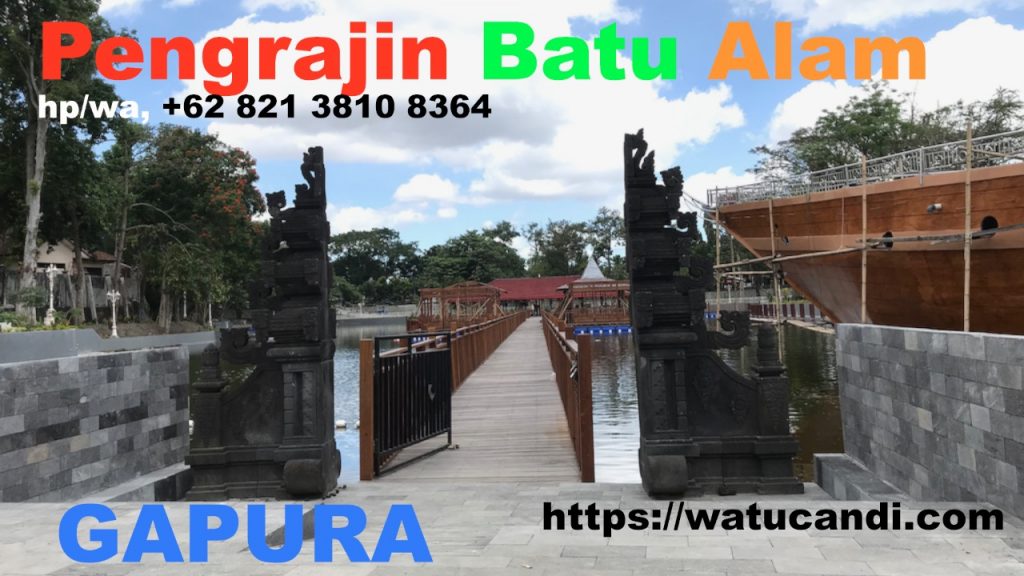
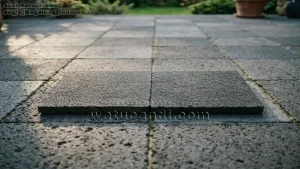
The image above shows how natural stone, in this case Candi stone or Merapi lava, is used not only as a flat inscription but also as a vertical structure like a gate. The rough yet dense texture of black lava stone gives an impression of authority and sturdiness. When used as an entrance marker or monumental inscription, this material can withstand the erosion of time, keeping the carved writing or symbols readable for future generations. The selection of natural stone for such elements is crucial because it must bear both structural loads and visual weight as a location icon.
In-Depth Definition: Inscriptions, Suprasasti, and Their Historical Context
To understand the essence of large inscription stones in gardens, we need to dissect their basic definition etymologically and historically. Generally, an inscription is a charter or official decision letter written on durable media, such as stone plates, copper, or bronze. The word comes from Sanskrit, meaning “praise” or “command”. In the context of Indonesian archaeology, inscriptions are the most important primary sources for reconstructing the history of ancient kingdoms such as Mataram Kuno, Sriwijaya, or Majapahit. Stone media was chosen for its “eternal” nature; it does not easily rot from termites like wood, and does not easily rust or crumble like certain metals when exposed to a humid tropical climate.
This natural and authentic impression is what makes large stone inscriptions often used as elements to beautify or decorate modern gardens. However, there is an important distinction to understand between inscriptions as historical artifacts and inscriptions as contemporary design elements. In the world of cultural heritage conservation, there is a term called suprasasti. Suprasasti refers to original inscriptions found at specific sites and left in their original location (in situ). Gardens or green areas are then built around them not to dominate, but to protect, honor, and facilitate study access for researchers and educational visits for the community. Revenue from garden tourism tickets is often allocated back to site maintenance.
Conversely, in the context of modern landscape architecture, “inscriptions” more often refer to replicas or new works of art created by mimicking ancient styles or using modern typography. Their purpose is not to record kingdom history, but to mark contemporary events, such as building inaugurations, honoring figures, or simply marking a place’s identity (landmark). This understanding is important so that we do not mix the sacred value of historical artifacts with the aesthetic value of garden decorative elements.
Man-Made Inscriptions: Social Functions and Modern Aesthetics
Man-made inscriptions are modern human creations designed specifically for certain purposes. Unlike ancient inscriptions that used Pallawa, Kawi, or Old Javanese scripts, modern inscriptions generally use Latin letters or local scripts that are easy for the general public to read today. Their size, shape, and material vary greatly, adjusted to their function and placement location. In modern life, these man-made inscriptions are used for several strategic purposes, including:
- Building or Place Inauguration: As legal and symbolic proof that a facility has been completed and is ready for public use.
- Commemorative Monument: To commemorate the death of someone, a hero, or a tragic/important historical event so it is not forgotten.
- Declaration of Promise or Oath: Writing down visions, missions, oaths of office, or joint commitments that are morally binding.
- Naming and Identity (Branding): Giving an official name to a location, park, or building so it has a strong identity.
- Education and Information: Presenting brief historical data or scientific facts about the location to visitors.
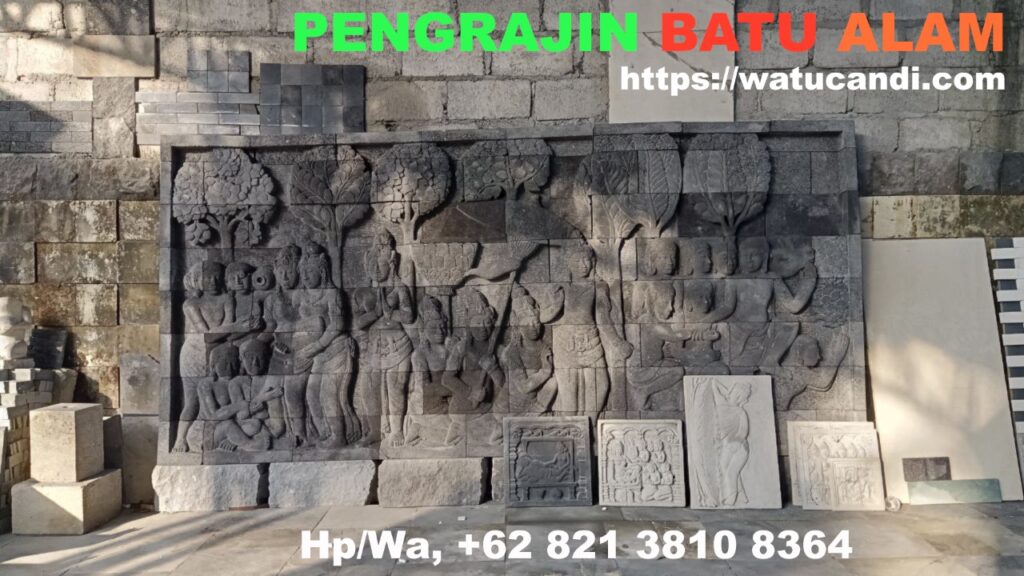
In addition to the functions above, there are inscriptions made intentionally to beautify a garden without heavy text content, but rather more towards calligraphy art or relief. This is called a decorative large garden inscription stone. There are two main types of this approach: completely new man-made inscriptions, and the integration of natural inscription elements. To explore various stone surface processing techniques suitable for inscriptions, you can see references about authentic manually chiseled stone floors which show how hand-made textures can add artistic value to stone surfaces.
Characteristics of Man-Made Large Inscription Stones
This type of stone is intentionally placed in the middle of a garden, carved in such a way that it creates the impression that the inscription is an integral part of nature, although it is actually a result of design engineering. This type of inscription is made from selected natural stone and carved by professionals or experienced stone craftsmen. The key to the success of a man-made inscription lies in material selection. The stone used is not just any stone or river stone with an indefinite shape. Rather, a whole stone with a wide flat field (slab) is required. The flat surface can be written on with high precision, either using direct chiseling techniques, sandblasting, or metal inlay.
The function of this man-made large inscription stone is for naming or inaugurating a place, such as mosques, temples, museums, government buildings, or other commercial buildings. The most commonly used material is Andesite (Candi/lava stone) because its dark color contrasts well with gold or white writing, and its high weather resistance. Another alternative is Palimanan Stone or Jogja Paras for a brighter and warmer nuance. For those looking for basic material inspiration for such projects, the collection of premium andesite and lava natural stone flooring can provide an overview of the quality of available volcanic materials.
- Natural Large Inscription Stone (Suprasasti)
For this natural large inscription stone, it is a protected site. A source from ancient civilization in the form of a large stone with writing carved on its surface. This type of natural inscription was not intentionally created by modern humans, but is an ancestral heritage. If man-made inscriptions are created after the garden is finished, then natural inscriptions are the main reason why a garden is created at that location. Besides protecting the natural inscription stone from vandalism and environmental damage, the creation of the garden also aims to generate income from the ancient site through educational tourism.
Strategic Functions of Large Inscription Stones in Gardens
There are several fundamental functions that people often cite as reasons for having large inscription stones in gardens. Their presence is not just to fill empty land, but to meet psychological, social, and administrative needs. Some of these functions are as follows:
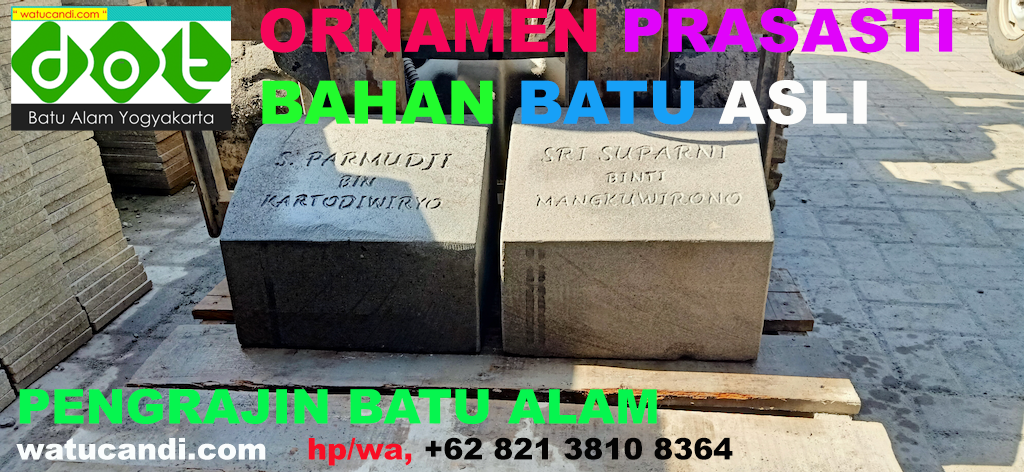
The image above, although a tombstone, illustrates the same principle as garden inscriptions: the use of natural stone (such as lava stone, black lava, or Candi stone) as a permanent medium for recording identity. The solid texture of the stone and its dark color give a solemn and serious impression. This principle is also applied to inauguration inscriptions in public parks, where the stone serves as a silent witness to the existence of an institution or event.
1. Proof of Legality and Inauguration of a Place
Have you ever been to a zoo, an old or grand mosque, a university, or other historical places? Usually, there is a large inscription located in the middle of the courtyard or in front of the main entrance. On top of that large inscription, the inauguration date, the name of the officiating official, and the project name are listed. So, the function of the large stone inscription is clear: as physical and legal proof that a place truly exists, has been completed, and its existence is recognized by government agencies or certain figures. Without an inscription, a building might feel “less legitimate” symbolically. Therefore, the function of this inscription stone is very important in state or corporate administration.
- 2. Reminder Sign (Memoria)
The second function is as a reminder. Besides being proof of a place’s establishment, the large garden inscription stone also serves as a chronological reminder of when the site or place was established. The words written on it also express a statement full of responsibility from the establishing party. As long as the inscription exists, the origin of the place or site will be remembered. In environmental psychology, reminder elements like this help the community build a sense of belonging to the public space. Therefore, this reminder symbolism is very important to maintain the community’s collective memory.
- 3. Identity and Branding of a Place
The presence of a large inscription stone in a garden provides a visual identity that people can use as a brand for that place. In the social media era, aesthetically designed inscriptions often become exclusive photo spots. Visitors will take photos next to the inscription to show that they are at that specific location. The meaning of identity is, when you remember that large stone, at that moment you also remember the place that has that large stone. This will make a site or place increasingly widely known. Unique inscription designs, for example using organic shapes or material combinations, can increase tourist appeal. For exterior design ideas combining natural stone, see the guide on lava stone exterior design.
- 4. Respect for Figures or Services
The next function is respect for certain figures. This function leans more towards historical and emotional aspects. Honoring a figure by carving their name, services, or inspirational quotes on the surface of a large garden inscription stone. Sometimes, a figure is very important in the process of establishing a place, whether as a donor, thinker, or leader. To honor the services of such a figure, creating a large stone inscription is one of the most noble and permanent ways. This has become very common for individuals or organizations as a form of eternal gratitude.
The four purposes of people making large garden inscription stones may cover all purposes of making inscription stones. However, implementation depends heavily on material selection and processing techniques. For more details, there are several examples of large stones and supporting materials that you can use as references in planning your project.
Morphology and Shape of Large Inscription Stones in Gardens
Generally, the shape of large garden inscription stones is vertically elongated (monolith) or horizontal (low slab). This shape choice is influenced by reading function and environmental context. On the front side or where the writing is, the surface must have a smooth texture (honed, polished, or fine bush-hammered finishing). So that the writing is clearly visible and easy to read from a certain distance. The contrast between the stone background and the writing color (usually gold, silver, or black paint) greatly determines readability.
On the sides without writing (sides and back), people often leave them like normal stone surfaces (natural split face or rough face) so that the natural impression is not lost. This technique creates harmony between the “cultural” side (written) and the “natural” side (rough). Inscriptions for a site are often large and massive. To look beautiful and become one of the icons worthy of being a photo spot, the stone’s proportions must be balanced with the garden’s scale. Do not make it too small until it gets lost, nor too large until it dominates aggressively.
The color of the writing on the surface of large inscription stones depends on the color of the stone itself. The principle of contrast is the key. If the stone is dark (such as Andesite, Basalt, or Black Lava), gold, white, or silver colors are usually used. If the stone is lighter (such as Palimanan, Jogja Paras, or Limestone), then the writing is colored black, dark brown, or maroon. The choice of paint color must also use exterior grade types that are UV resistant so they do not fade within months.
Case Studies: Examples of Iconic Garden Inscription Stones
In this discussion, We will explain several examples of large garden inscription stones that you may need to know as a benchmark or quality standard. Some of these inscription examples can serve as examples if you want to make an inscription for your home, housing complex, or public building.
1. Large Stone Inscription for Borobudur Temple Restoration
In the past, Borobudur temple suffered significant damage due to natural disasters (Mount Merapi eruption) and neglect over centuries. This caused sorrow in the worlds of history and culture. Through international efforts led by UNESCO and fully supported by the Indonesian Government, the temple was finally repaired with support from many parties. After repair, people erected a large stone inscription as a warning that Borobudur temple had been restored. Specifically, this was during the leadership of the second President, Soeharto. Besides Soeharto’s name on the large stone, there are also logos and writings from donor countries and UNESCO. Several involved parties who contributed to the restoration of Borobudur temple were immortalized in sturdy black andesite stone, becoming witnesses to international cooperation history.
2. Central Java Grand Mosque (MAJT) Inscription
When the Central Java Grand Mosque was built as a new religious landmark, they also erected a large inscription written with “Construction of the Central Java Grand Mosque”. Its placement location is strategic in the main plaza area. Besides that, the establishment date (Hijriyah and Gregorian years) has been written on it. Also who inaugurated it (the President of RI at that time). Same as the previous Borobudur Temple restoration, the function of this large stone inscription is as a time reminder and identity of the Central Java Grand Mosque. Even, if you visit this Mosque, it feels incomplete if you do not photograph this inauguration site as proof of visit. The materials used are usually local natural stone combined with modern elements.
3. Surabaya Heroes Monument Large Stone Inscription
Next is the large inscription stone located in the Surabaya Heroes Monument complex. This large stone has writing carved on it containing poems or narratives of struggle. The stone commemorates the history of Surabaya heroes’ struggle in the November 10, 1945 battle for independence. Besides serving as a reminder and history lesson for the younger generation, this inscription stone also reflects an icon of the Heroes Monument. The placement of this stone is also in the right position, making it easy for tourists to reach, read, and reflect. The chosen stone texture is often rough to depict the hardness of the struggle.
4. Mentari Beach & Tourist Area Large Stone Inscription
Not only historical sites are suitable for large stone inscriptions. Natural tourist areas like beaches are also suitable for large stone inscriptions as a form of warning and boundary marker. Mentari Beach is a housing and tourist location that has an inauguration inscription in the form of a large dark white stone (possibly using limestone or dark palimanan types). On it, there is black writing that embodies the hopes of Mentari beach to become a family-friendly destination. The surface of this inscription serves as a neat base. Meanwhile, the other sides are left rough like general stones. Besides embodying a natural and authentic impression, this large stone inscription also becomes a photogenic icon on the beach edge.
Technical Guide: Choosing Natural Stone Materials for Inscriptions
Choosing the right stone for an inscription is a critical decision. Inscriptions are intended to last for tens or even hundreds of years. Therefore, durability, porosity, and aesthetics factors must be carefully considered. Below is an in-depth analysis of natural stone types ideal for garden inscriptions:
1. Andesite Stone (Merapi Lava/Candi)
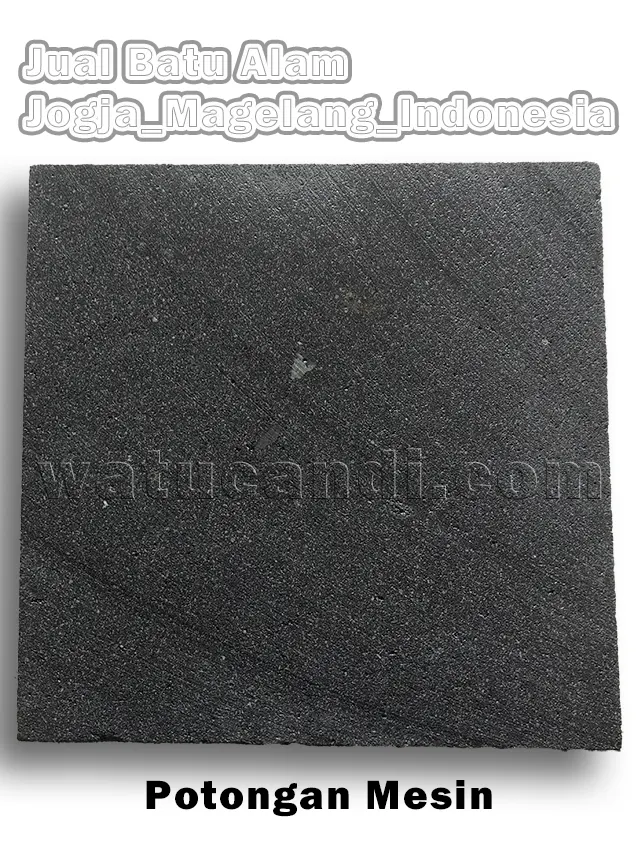
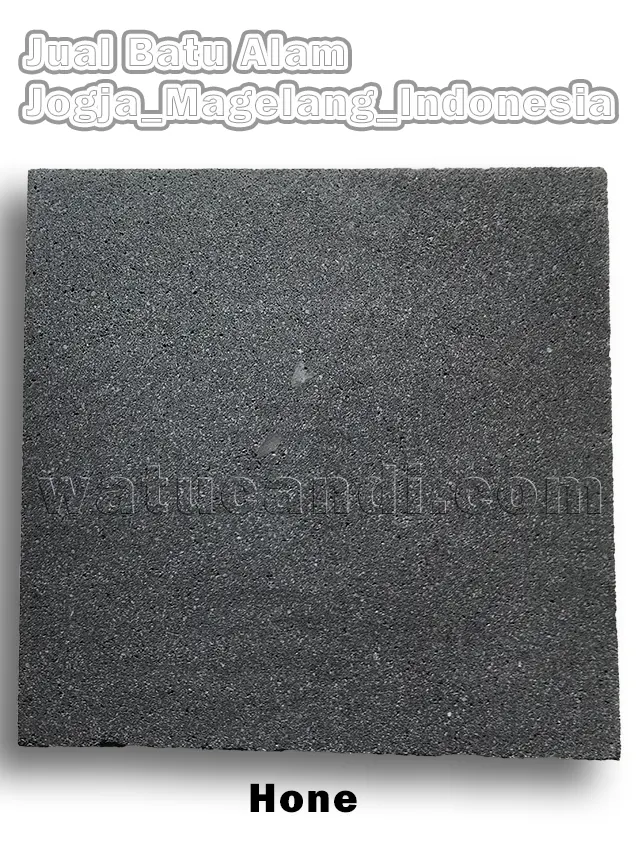
Andesite Stone, especially those from Mount Merapi eruptions (often called Candi stone or Black Lava), is the number one choice for inscriptions in Indonesia. Its dark gray to pitch-black color provides perfect contrast for gold or white writing. Geologically, andesite is a volcanic igneous rock that is very hard, dense, and has low porosity. This makes it very resistant to acid rain, scorching heat, and moss growth (if treated with coating). Its texture can be finished smooth (honed) for the writing area, while the sides are left rough (split face) for a natural impression. Its main advantage is extraordinary structural strength; this stone is almost impossible to break from ordinary impacts. To see andesite product variations, visit Merapi lava natural stone paving.
2. Palimanan Stone (Sandstone)
If you want a warmer, classic, or “earthy” nuance, Palimanan Stone is the choice. Originating from Cirebon, this sandstone has cream, light yellow, to light brown colors. Its characteristic fiber motif provides visual beauty even without writing. Palimanan is relatively softer than andesite, making it easier to carve for intricate calligraphy details. However, because it is sedimentary, it is more porous and prone to moss if not coated regularly. Palimanan inscriptions are very suitable for Mediterranean, Classic Tropical, or Colonial style gardens. Learn more about Palimanan paras stone tiles to understand its characteristics.
3. Limestone Stone (Lime/Chalk)
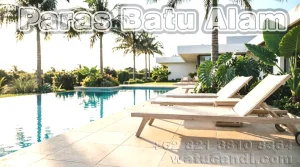
Limestone Stone, including variants like Jogja Paras or Kebumen, offers clean white to pale cream colors. The impression is very elegant, pure, and minimalist. This stone is very popular in modern minimalist architecture due to its ability to reflect light and make spaces feel larger. However, limestone is very sensitive to acid. Avoid cleaning with harsh chemicals. Limestone inscriptions are very suitable for shaded garden areas or semi-outdoor (open but roofed) areas. For a complete guide, read limestone and travertine stone guide.
4. Sukabumi Stone (Green Stone)
Although more famous for swimming pools, Sukabumi Stone (Zeolite) can also be used for inscriptions with a unique concept. Its natural green color gives a cool impression and blends with garden vegetation. However, due to its dominant green color, writing readability can be a challenge unless using metal inlay techniques or very thick contrasting paint. This stone is very water-resistant and actually becomes more beautiful when wet. See Sukabumi green stone tiles for color reference.
Inscription Stone Processing and Finishing Techniques
After choosing the material, the next step is determining the processing technique. The quality of the inscription is largely determined by how the writing or image is applied to the stone.
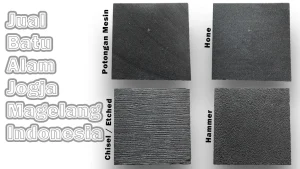
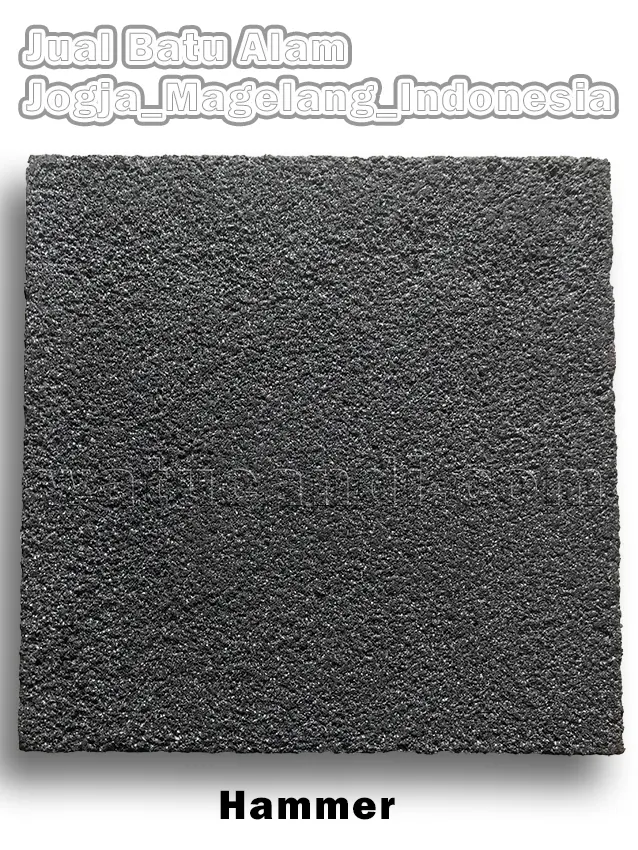
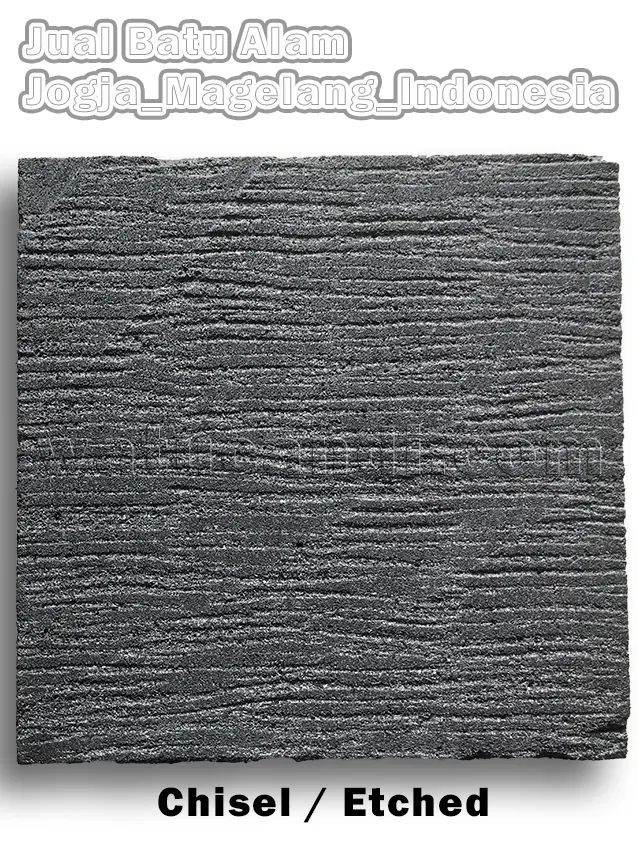
1. Manual Chiseling (Hand Chiseled): A traditional technique where craftsmen use chisels and hammers to carve letters directly into the stone. The result has real depth, providing natural shadows that make the writing readable from various light angles. This technique requires high expertise and time, but the result is very artistic and has high artistic value. Suitable for inscriptions with Javanese or Arabic calligraphy. Reference: chiseled stone installation patterns.
2. Sandblasting: A modern technique using high air pressure and abrasives to erode the stone surface according to a stencil pattern. The result is flat and precise, suitable for printed Latin letters or company logos. Processing speed is faster than manual chiseling, but the carving depth is usually shallower.
3. Metal Inlay: Letters or symbols are made from brass, stainless steel, or bronze plates, then attached or embedded into stone grooves. This provides a very luxurious material contrast (cold stone vs shiny metal). Very suitable for inauguration inscriptions for luxury buildings or five-star hotels.
4. Coating and Protection: Regardless of the technique, outdoor inscriptions must be coated with water-resistant and UV-resistant coating. “Doff” or “natural look” type coatings are recommended so the stone remains looking natural without an excessive shiny impression that looks fake. Coating also prevents the growth of moss and fungi that can obscure writing. For maintenance tips, see lava stone cladding maintenance guide.
Integrating Inscriptions with Other Garden Elements
Inscriptions should not stand alone visually. They must dialogue with surrounding garden elements. Here are design integration tips:
Lighting: Use uplights or spotlights from below to highlight the inscription at night. Light sweeping across the stone surface (grazing light) will highlight the carving texture and make the writing more dramatic. Ensure the light source does not cause glare for readers.
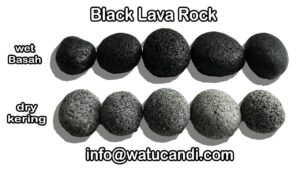
Landscaping: Plant low plants around the base of the inscription, such as Japanese grass, ferns, or small contrasting colored flowers. Avoid planting large trees directly behind the inscription whose roots can damage the stone foundation in the long term. Use gravel or coral stones around the base of the inscription for good drainage. See black lava rock pebbles guide for base decoration options.
Foundation: Ensure the inscription is planted on a strong concrete foundation. Large stones have significant mass; if only placed on soil, they can tilt or sink when heavy rain erodes the soil. Planting depth should be at least 1/3 of the total stone height for maximum stability.
Latest Trends: Interactive and Digital Inscriptions
In the digital era, the concept of inscriptions is evolving. Some modern gardens now embed QR Codes on inscription stones. Visitors can scan the code to access complete historical information, documentary videos, or audio guides about the site. This combines the physical permanence of stone with the flexibility of digital information. The stone remains the physical anchor, while digital content can be updated without damaging the stone. This is an evolution of the inscription’s function as a data storage medium.
In addition, the “Living Stone” trend or inscriptions designed as part of irrigation systems or garden seats is also emerging. Stones are no longer just objects to view, but functional objects. For example, an inscription stone shaped elongated and can be sat on, while displaying the names of garden donors. This multifunctionality increases the utility of garden space.
Conclusion: Heritage in Stone
Large Inscription Stones in Gardens are more than just piles of carved stones. They are bridges of time, guardians of memory, and sturdy identity markers. Choosing to install natural stone inscriptions is a decision to invest in eternity. By choosing the right materials such as Merapi Andesite, Palimanan, or Limestone, and applying professional processing techniques, you create a heritage that will be enjoyed and read by future generations. Hopefully, this information can benefit you in designing meaningful public or private spaces. Make every scratch on the stone an eternal sentence, and every stone a faithful silent witness.
For further exploration regarding various types of natural stone, installation techniques, and other architectural design inspirations, please visit the following reference links that we have curated to complement your insights:
Comparison of local vs precision green stone | Ultimate guide for green stone for pools | Ultimate guide for Indonesian lava stone | Random candi stone skin cladding | Candi lava natural stone mosaic | Original random stone slabs | Pumice stone | Natural stone and furniture | Yogyakarta batik green stone tiles | Breksi natural stone tiles | Natural stone liquid soap dispenser | Natural rough surface marble stone sink | Black basalt stone sink | Lava stone tiles for swimming pool | Handmade stone table and chairs | 9 types of GC stone | 8 types of GCBroken stone | 7 surface types 0.5×0.5 comb | 5 surface types 3×1 | 4 line types 2×1 | 3 line types rooling | Line types 0.5×0.5 broken regularly | Straight line type 1×0.5 | Floor paving stone chisels | Swimming pool coping stone tiles complete guide | Top table black lava stone | Green stone split face tiles | Lava rock tiles premium volcanic stone cladding | Black lava stone tiles 10x10x1cm guide | Ultimate guide to swimming pool stone tiles | Black lava stone tiles 2 | Black lava stone tile walls ultimate guide | Brown Java tiger stone slabs and black paras sandstone guide | Lava rock stepping stone pavers ultimate guide | Garden wall foundation stone borders ultimate guide | Indonesian green stone tile crafts ultimate guide | Stone fence and foundation walls ultimate guide | Split face rough batu candi temple | Borobudur temple stone | Temple stone paving floor | Black lava natural stone tile | Limestone tile bushhammer | Sandstone limestone natural stone from Indonesia | Indonesian limestone tiles natural stone wall floor | Merapi natural stone outdoor flooring | Handmade stone tub | 3D stone slabs | Tumbled natural stone finish | Stone floor lava stone floor | Garden and yard stone flooring | Lava stone paving slabs | Irregular natural stone paving | Original Merapi stone sink 49x49x13cm | Batik green natural stone Yogyakarta | White Palimo Palimanan natural stone | Super White Palimo limestone | Green natural stone | Getting to know umpak batu | Carved temple lava stone | Brown spotted paras stone | Black lava natural stone tile | Hidden crystals of Merapi lava | Chiseled temple natural stone | Chiseled natural stone paving | Chisel lava natural stone | 300x300mm chiseled lava stone surface | Andesite natural stone slabs | Slate stacked betel leaf slab surface | Flat random riverstone natural stone | Example of candi stone paving | Lava stone semi carved | Genuine susun sirih slate | Hand carved temple stone flooring paving | Natural stone edge wall | Stone floor of the temple Merapi lava | Lava paving stepping stones | Rough face stone floor | Solid split stone size 100x200mm | Black lava stone Bali Indonesia | Rough natural stone floor | Sell pelinggih stone materials | Black lava bush hammer surface | Black candi lava stone | Black lava stone 100x100x10 | 5 black lava stone surfaces | Black slab natural stone | Lava stone rough face | Black lava | Lava stone floor temple | Lava stone 75x230mm | Lava stone products | Decking parquet Merapi lava stone | Lava alkali sawncut vs bushhammer | Lava stone | Lava candi natural stone | Natural stone edges | Natural stone slabs | Andesite stone paving Indonesia | Green Sukabumi natural stone | Wavy carved natural stone tiles | Natural andesite stone | Commercial design | Enterprise design | Hospitality design | Restaurant design | Industrial design | Luxury home design modern | Unique models of beautiful products | Latest styles | Decorate comfort design | Brown sandstone | Natural stone tiles | Black lava candi stone Merapi complete guide | Merapi lava candi natural stone complete guide | Large natural limestone slabs complete guide | Candi lava split face stone technical specifications | Chiseled candi stone paving manual guide | Brown Java sandstone tiles premium supplier | Natural stone as swimming pool gutter cover guide | Merapi black sand split face natural stone guide | Hard cream limestone natural stone complete guide | Garden floor yard assorted irregular random stepping stones guide | Merapi lava temple stone balls | Merapi mountain talud stone material | 20×40 Sukabumi green stone complete guide | Jogja limestone versatile natural material | Ordering tombstones kijing plisir | Natural stone tactile paving for sidewalks | Natural stone stacked wall cladding comparison | Solid natural stone furniture sink | Natural stone stepping stones in the garden guide | Black white wall cladding combination guide | Pool coping stone tile materials complete guide | Raised and recessed natural stone cladding guide | Black lava candi stone wall cladding guide | 4 surface finishes for basalt granite and andesite | Paras limestone natural stone complete guide | Selling honed sawn cut basalt stone complete guide | Wall aesthetics revolution complete guide | Batik basalt granite natural stone exotic charm | Classic black basalt granite complete guide | Natural stone skin slab surface complete guide | Hand chiseled candi stone paving complete guide | Green batik natural stone Bali green aesthetics | Small square natural stone pavers complete guide | Large garden ornamental stones for sale | Black lava candi natural stone aesthetics | Black basalt granite natural stone aesthetics | Basalto batik natural stone granite tiles | Small square natural stone garden pavers art | Merapi volcanic stone umpak | Garden stepping stone paving block | Refined rough face natural stone | Deep exploration of natural stone patterns
large stone inscription, garden inscription, andesite stone, candi stone, suprasasti, garden design, landscape architecture, Indonesian natural stone, stone monument, stone history, Merapi lava stone, stone carving, garden ornament, palimanan stone, limestone stone