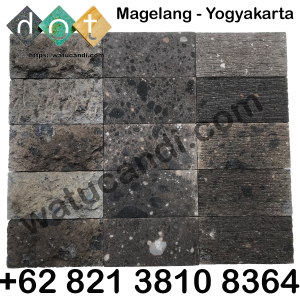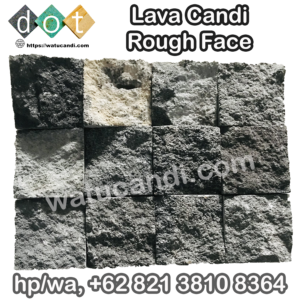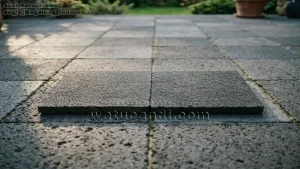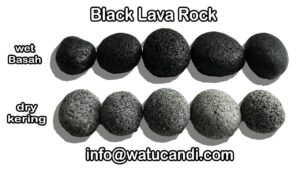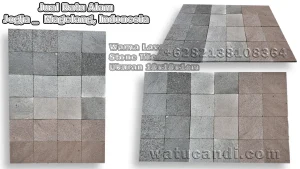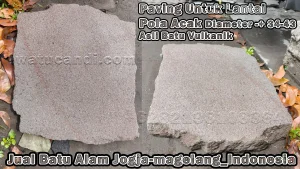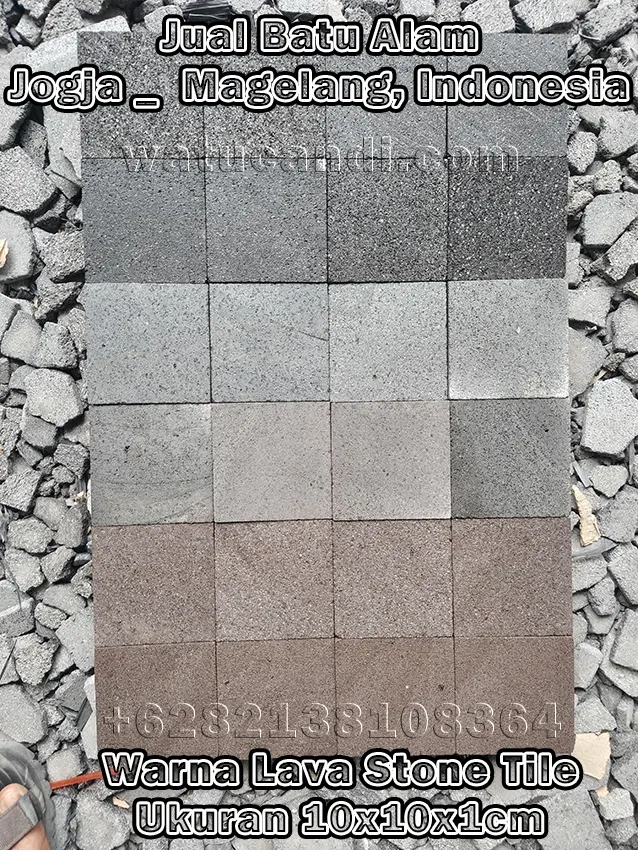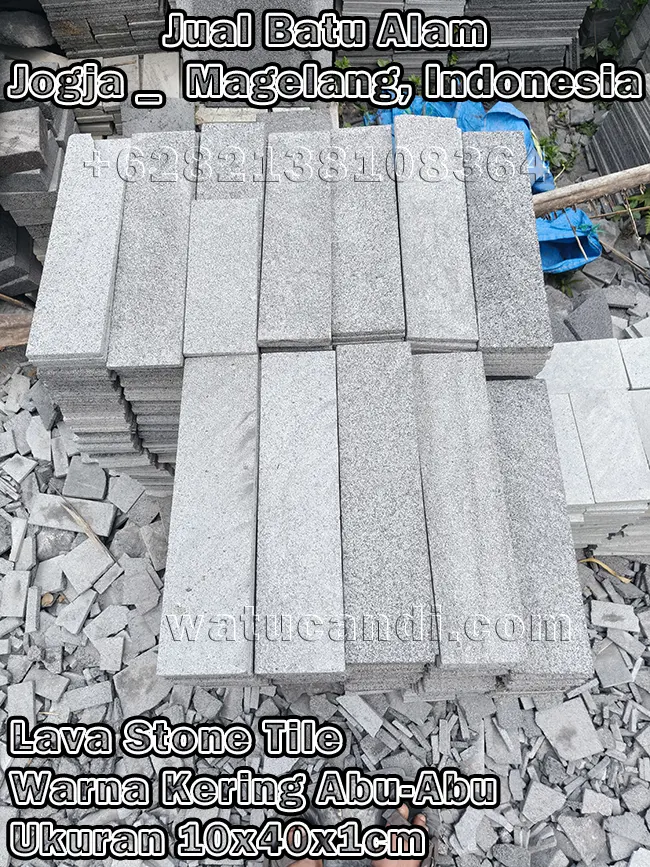
Not just a floor, but a hand-carved Merapi heritage. Discover why 30x30x5 cm manual chiseled candi stone paving is the top choice for architects to create living spaces, from the secrets of millennia-old durability to tricks for selecting the right grade so your project does not go over budget.
In the landscape of tropical architecture and cultural heritage design, selecting flooring material is not merely about functional footing, but also about historical narrative and endurance against time. Manual chiseled candi stone paving with precise 30x30x5 cm dimensions represents the perfect intersection between the geological strength of Mount Merapi and the refinement of traditional Nusantara carving art. This material is not just a floor tile; it is a functional artifact that brings authentic volcanic character into modern homes, resort villas, and cultural conservation areas.
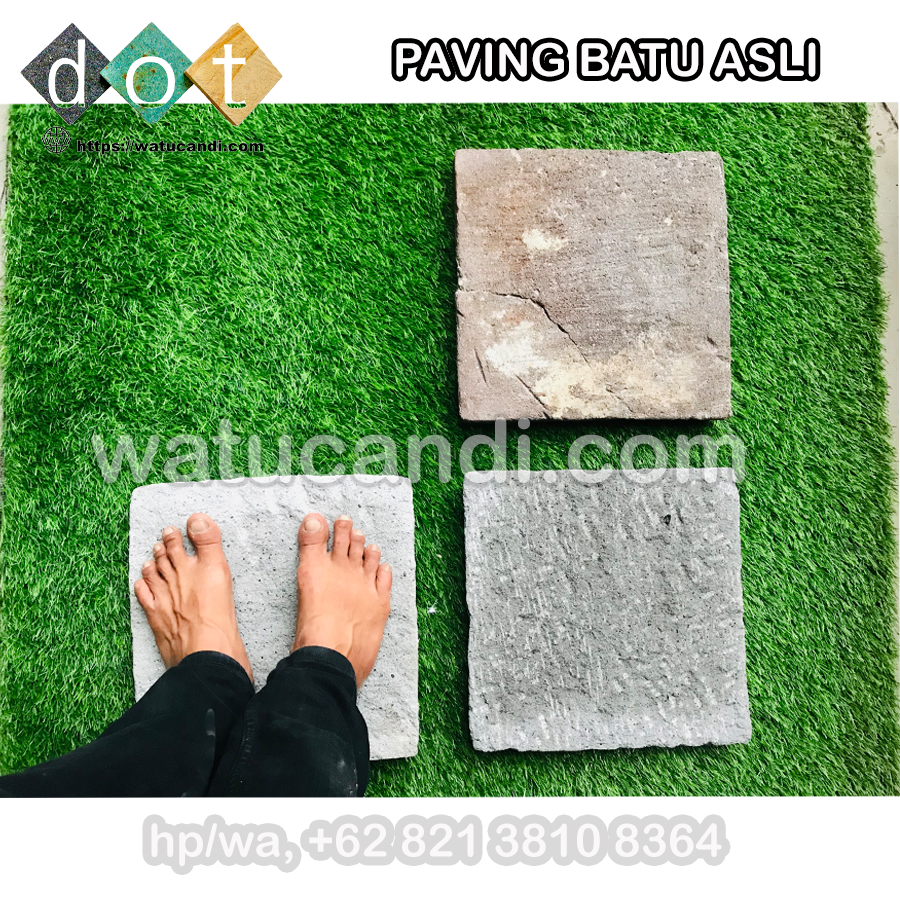
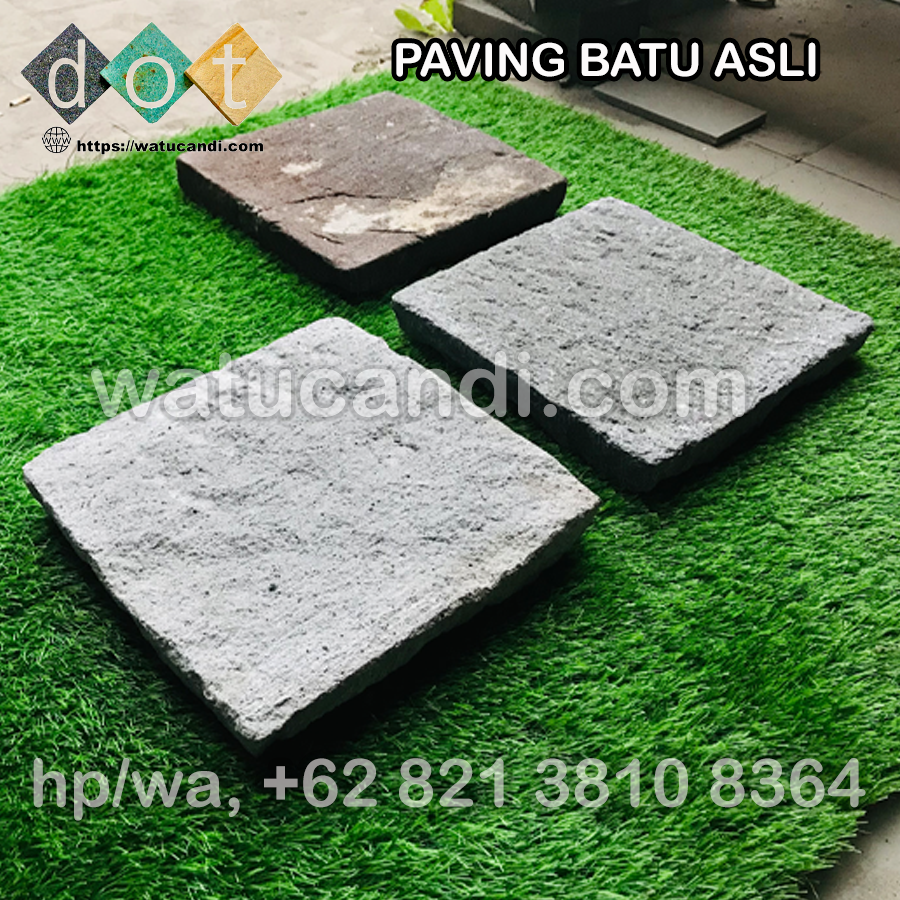
The 30x30x5 cm size is strategically chosen as the gold standard for both heavy-duty and aesthetic applications. The 5 cm thickness provides structural integrity far exceeding conventional thin ceramics or natural stones, allowing it to withstand light vehicle loads, intensive pedestrian traffic, and thermal pressure without risk of cracking. Meanwhile, the manual chisel finish creates a surface texture that is not only naturally anti-slip but also radiates an authentic aura that cannot be replicated by modern factory machines.
This article will thoroughly dissect every technical, aesthetic, and practical aspect of 30x30x5 cm manual chiseled candi stone paving. From the cold lava extraction process and traditional carving techniques to comparisons of local versus precision quality, professional installation guides, and integration with other design elements. For architects, contractors, property owners, and natural stone enthusiasts, this comprehensive guide is compiled as a definitive reference before making material investment decisions.
Material Anatomy: Understanding Merapi Lava Candi Stone
Before discussing dimensional specifications and finishes, it is crucial to understand what Merapi lava candi stone is geologically and historically. This knowledge forms the foundation of why this material has superior performance compared to andesite rocks from other regions in Indonesia.
Volcanic Genesis: Cold Lahar vs Hot Lava
The candi stone we process comes from cold lahar (rain lahar) deposits of Mount Merapi, not from active hot lava flows. Cold lahar is formed from pyroclastic material carried by rainwater post-eruption, which then solidifies over thousands of years to form highly dense andesitic-basaltic rock. This natural sedimentation and compaction process produces a tight crystalline microstructure with minimal large air cavities, yet retains micro-porosity that allows the stone to breathe.
Unique characteristics of Merapi cold lahar include consistent dark grey color, high density (2.6-2.8 g/cm³), and exceptional abrasion resistance. For a deep understanding of the technical differences and complete specifications of this material, please refer to the Complete Guide to Black Lava Candi Stone Merapi. That document explains in detail the physical parameters that make it the standard material for earthquake-resistant and extreme weather-resistant buildings.
Historical Heritage: From Borobudur to Modern Architecture
The term “candi stone” is not merely a trade name, but a historical acknowledgment. This material is identical to the stone used in the construction of Borobudur Temple, Prambanan, and hundreds of other archaeological sites in Central Java. In fact, many original stone blocks from these temples still stand strong after more than a thousand years of exposure to tropical rain, sun heat, and seismic activity.
When you choose 30x30x5 cm manual chiseled candi stone paving, you are adopting material technology that has been time-tested for a millennium. Historical references and contemporary applications of this legendary material can be explored further through the articles Borobudur Temple Stone and Merapi Lava Temple Stone Floor. This historical context adds invaluable value to your property, transforming ordinary floors into high-cultural storytelling elements.
Technical Specifications of 30x30x5 cm Dimensions: Why Is This Size Ideal?
In the Watucandi catalog, the 30x30x5 cm size occupies a strategic position as a versatile format. Here is a technical analysis of why these dimensions are the primary choice for various architectural scenarios:
Structural Integrity of 5 cm Thickness
A thickness of 5 cm (50mm) is the recommended minimum limit for natural stone paving that will receive dynamic loads. Unlike thin 1-2 cm tiles suitable only for walls or light interior floors, 5 cm thickness provides:
- Vehicle Load Capacity: Capable of withstanding passenger cars and SUVs without risk of breaking, provided it is installed on an adequate substrate (compacted sand or concrete).
- Flexural Resistance: Reduces the risk of cracking due to uneven settlement often occurring in exterior areas.
- Thermal Stability: Greater thermal mass helps dampen daily temperature fluctuations, preventing excessive expansion and contraction that could damage grout joints.
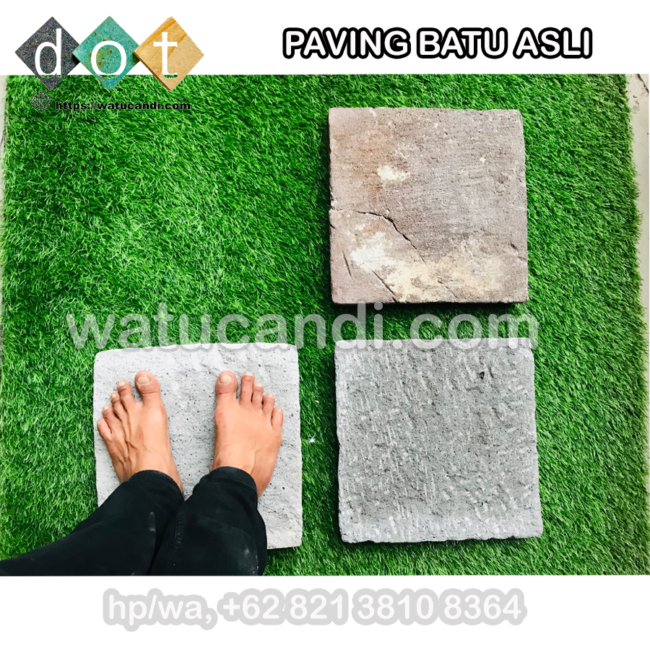
- Stepping Stone Compatibility: Thick enough to be partially embedded in soil or grass without losing stability, creating an elegant floating effect.
For projects requiring different specifications, Watucandi also provides other size variations such as Black Lava Tiles 100x100x10 mm for premium pedestrian areas, or large slab formats at Black Natural Stone Slabs for spacious terraces with fewer joints.
Modularity of 30×30 cm Grid
The 30×30 cm size offers a perfect balance between installation efficiency and visual proportion. Not too small so that joints dominate, and not too large so that it is difficult to adjust to complex patterns. This format is compatible with various classic and contemporary installation patterns:
- Straight Grid Pattern: Creates a neat, modern, and formal impression. Suitable for corridors, minimalist house terraces, or commercial areas.
- Running Bond Pattern: Provides visual dynamics and strengthens interlocking bonds. Ideal for pathways and parking areas.
- Pinwheel or Modular Pattern: Can be combined with other sizes such as 10×10 cm or 20×20 cm to create rich geometric motifs.
- Separated Stepping Stones: Installed with center-to-center spacing of 40-50 cm as jump pads over grass or gravel.
More varied chiseled stone installation pattern inspirations can be explored through the Chiseled Natural Stone Installation Patterns guide. Selecting the right pattern can significantly alter spatial perception, making narrow areas feel wider or vast areas feel more intimate.
The Art of Manual Chisel Finishing: Between Tradition and Precision
Manual chisel finishing is the soul of this product. In an era dominated by CNC machines and pneumatic bushhammers, hand carving maintains its relevance for reasons that technology cannot replace:
Traditional Carving Process
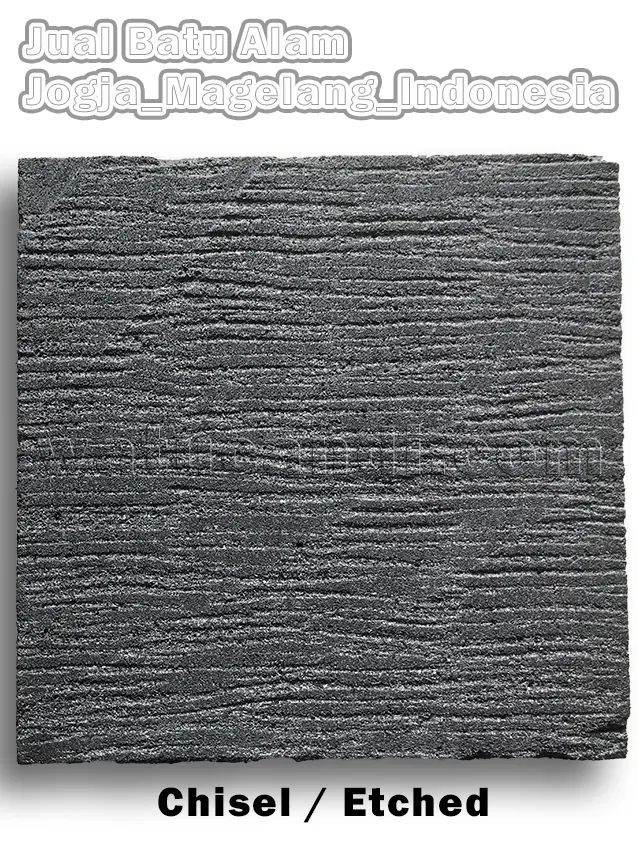
Each sheet of 30x30x5 cm paving is carved by experienced artisans using specialized iron hammers and chisels. This technique involves a specific rhythmic striking that creates parallel or cross grooves with varying depths (typically 2-5mm). It is this depth variation that distinguishes manual chisel from machine chisel:
- Organic Irregularity: No two stones are 100% identical. Subtle variations between stones create a living and non-monotonous surface.
- Superior Anti-Slip Texture: Manual carving grooves tend to be sharper and deeper than machine bushhammering, providing exceptional traction even when wet and mossy.
- Heritage Aesthetics: Hand-carved traces carry the collective memory of classic Javanese-Balinese architecture, highly valued in ethnic-themed villa and resort designs.
To see other chiseled finish variants including semi-carved and surface combinations, visit the Chiseled Floor Paving Stone and Chiseled Lava Natural Stone pages. Each carving type has distinct visual character and friction performance, allowing customization according to building functional zones.
Comparison: Manual Chisel vs Bushhammer vs Sawncut
Choosing the right finish requires comparative understanding. Here is a summary of key differences:
| Aspect | Manual Chisel | Bushhammer | Sawncut |
|---|---|---|---|
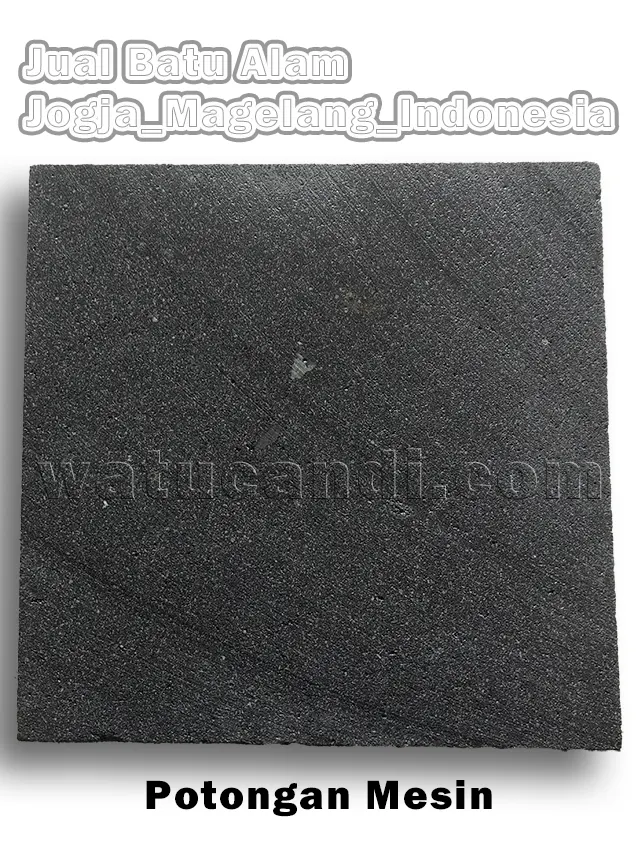
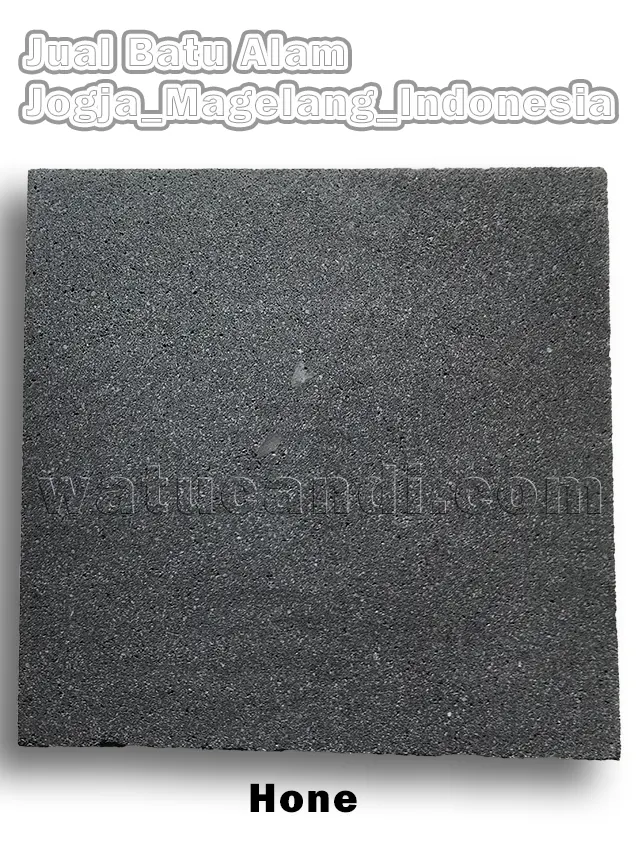
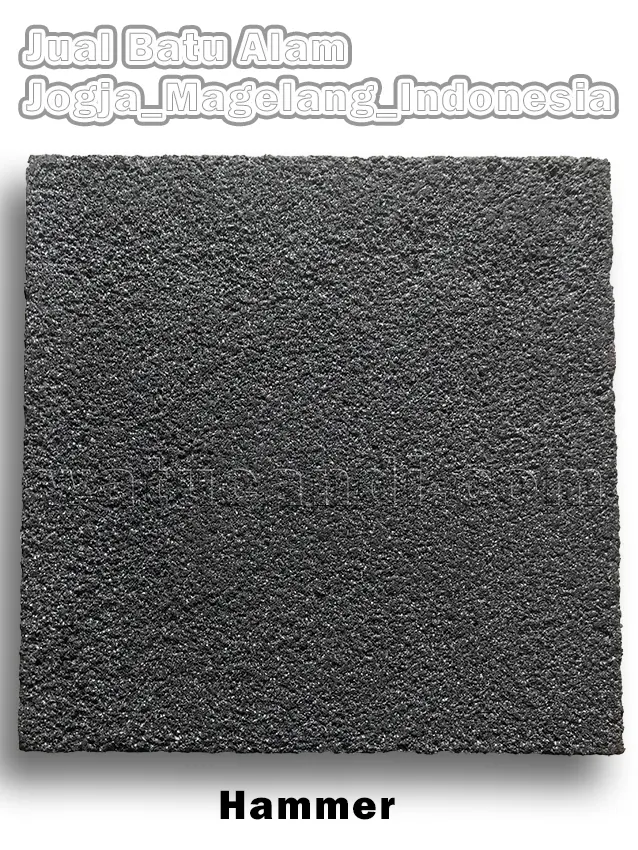
| Texture | Linear/cross grooves, varying depth | Uniform rough dots | Smooth, flat, saw mark texture |
| Anti-Slip | Very High | High | Moderate (slippery when wet) |
| Aesthetics | Rustic, traditional, artisanal | Industrial, modern, uniform | Clean, minimalist, contemporary |
| Consistency | Varied (handmade charm) | Very Uniform (machine) | Very Uniform |
| Price | Premium (labor intensive) | Moderate | Economical-Moderate |
| Ideal Application | Ethnic villas, gardens, wet areas, heritage | Sidewalks, parking lots, public plazas | Interiors, covered terraces, walls |
A deeper analysis comparing alkali sawncut versus bushhammer finishes is available in the Lava Alkali Sawncut vs Bushhammer Comparison article. For alternative rough surfaces, consider also Rough Face Lava Stone and Black Lava Bush Hammer Surface as comparison options before finalizing decisions.
Architectural Applications: From Classic Joglo to Contemporary Villas
The versatility of 30x30x5 cm manual chisel paving makes it relevant for a wide spectrum of architectural styles. Here is an application guide based on space typology:
Vernacular Architecture: Pendopo, Joglo, and Limasan
For traditional Javanese wooden buildings, manual chiseled candi stone is the most authentic material pairing. The cool dark grey color balances the warmth of teak wood, while its rough texture dialogues harmoniously with natural wood grain.
- Open Pendopo Floor: Use a straight grid pattern with 1-2 cm wide joints filled with sand or fine gravel for optimal drainage.
- Surrounding Veranda: Combine with Lava Paving Stepping Stones as a transition from dry areas to the garden.
- Umpak Area: Pair with Getting to Know Umpak Stone as wooden column bases, creating visual unity from foundation to roof.
Premium collections for courtyards and joglo villas are available at Premium Natural Stone Flooring Collection by Watucandi, which curates the best material combinations for luxury vernacular architecture.
Garden Landscapes and Exterior Areas
In garden areas, 30x30x5 cm paving serves a dual function as functional and aesthetic hardscape elements:
- Pathway: Install as stepping stones with 15-20 cm spacing between stones, filled with Japanese grass or Black Lava Rock Pebbles for stunning textural contrast.
- Outdoor Seating Area: Create an elevated platform 5-10 cm above ground level using this paving as permanent decking. Combine with Handmade Stone Tables and Chairs for a cohesive furniture set.
- Borders and Edging: Use as dividers between lawn areas and plant beds. Edge wall details are available at Natural Stone Edge Wall and Natural Stone Edges.
- Light Driveway: For carports or driveway entrances, ensure reinforced concrete substrate and use herringbone or running bond patterns for optimal load distribution. Reference for andesite driveway paving: Andesite Stone Paving Indonesia.
A complete design and installation guide for volcanic stepping stones is available at The Ultimate Guide to Lava Rock Stepping Stone Pavers. For general garden and yard flooring, also read Garden and Yard Stone Flooring.
Interior and Semi-Outdoor Areas
Although generally associated with exteriors, 30x30x5 cm manual chisel is increasingly popular for interiors desiring a raw and grounded nuance:
- Terrace and Veranda: Seamless transition between indoor and outdoor. Ensure sealing is done to prevent carving dust from entering the house.
- Dry Bathroom & Spa: Its anti-slip texture is ideal for wet areas. However, for continuously submerged areas (shower floors, pools), consider smoother finishes or combine with Lava Stone Tiles for Swimming Pools specifically designed for immersion.
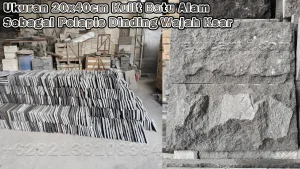
- Interior Accent Walls: Besides flooring, the 30x30x5 cm format can be applied as wall cladding to create dramatic feature walls. See cladding inspiration at Black Lava Stone Tile Walls Guide and Premium Volcanic Stone Cladding.
For modern luxury interior design inspiration integrating natural stone, visit Modern Luxury Home Design and Comfort Decor Design.

Local vs Precision Quality: Choosing the Right Grade
One of the most important decisions when ordering candi stone paving is choosing the quality grade. Watucandi offers two main categories serving different market segments:
Local Grade (Standard)
Local grade is produced with looser dimensional tolerances (±3-5mm) and freer chisel texture variations. Its characteristics include:
- More Economical Price: Suitable for limited-budget projects or areas not demanding high precision (backyards, service paths, fences).
- Strong Rustic Character: Variations in size and texture become attractions for designs intentionally seeking imperfect and organic impressions.
- Wider Joints: Requires 1.5-3 cm joints to accommodate tolerance, which can be filled with grass or gravel for a natural effect.
Precision Grade (Export Quality)
Precision grade undergoes additional calibration processes and strict quality control. Dimensional tolerance ±1mm, precise 90° square corners, and consistent chisel texture selection.
- Neat & Fast Installation: Thin joints (3-5mm) are possible, speeding up installation and reducing filler material consumption.
- Perfectly Flat Surface: Minimal trip hazards, comfortable for barefoot walking, and easy to clean.
- Premium Aesthetics: Mandatory for hospitality projects, luxury villas, high-end public areas, and international exports.
Detailed comparisons between local and precision quality (including green stone as a calibration principle reference) are available at Local vs Precision Green Stone Tiles Differences. For semi-chiseled paving with premium finishing, also see Merapi Lava Candi Stone Semi-Chiseled Paving Guide.
Recommendation: For representative areas (front terraces, lobbies, pool decks), always choose precision grade. For utility areas or naturalistic gardens, local grade offers the best value.
Professional Installation Guide: Ensuring Long-Term Durability
Premium material quality can be wasted if installation is done carelessly. Here are recommended installation protocols for 30x30x5 cm manual chisel paving:
Substrate Preparation
The substrate is the foundation determining paving lifespan. Three common substrate options:
- Compacted Sand (Sand Bedding): For pedestrian areas and stepping stones. A 3-5 cm layer of river sand is leveled and compacted. This method allows vertical drainage and flexibility against slight soil movement.
- Reinforced Concrete (Concrete Base): Mandatory for vehicle areas or soft soil. Pour minimum 10 cm thick concrete with wiremesh, provide 1-2% slope for drainage. Paving is adhered with special natural stone adhesive.
- Native Soil (Direct on Soil): Only for separated stepping stones. Dig holes as deep as stone thickness + 3 cm, fill with compacted sand, embed stone until flush with ground/grass surface.
Installation Techniques
- Dry-Fit Layout: Always perform a dry-fit (arrange without adhesive) first to verify patterns, minimize cuts, and ensure alignment.
- Adhesive Usage: For installation over concrete, use flexible C2TE S1 class adhesive or equivalent. Do not use regular cement due to delamination risk.
- Joints and Filling: For sand joints, use polymeric sand that hardens when watered to prevent erosion and weed growth. For cement joints, use flexible grout with latex additive.
- Cutting: Use diamond blades specifically for natural stone. For cut chisel edges, perform manual re-chiseling so cut marks do not look smooth/shiny, disrupting rustic aesthetics.
Examples of correct candi paving installation can be seen at Example of Candi Stone Paving Installation. For varied chiseled stone installation patterns, refer to Chiseled Natural Stone Installation Patterns.
Installation Mistakes to Avoid
- ❌ Installing Over Soft Soil Without Compaction: Causes uneven settlement and broken paving.
- ❌ Ignoring Drainage Slope: Standing water accelerates joint deterioration and excessive moss growth.
- ❌ Using Regular Cement as Adhesive: Pure portland cement is too rigid and lacks sufficient bonding strength for porous natural stone.
- ❌ Not Sealing (for certain areas): Areas exposed to oil, wine, or staining agents must be sealed to prevent permanent staining.

Care and Maintenance: Preserving Beauty for Decades
Merapi lava candi stone is renowned for being low-maintenance, but preventive care will significantly extend its aesthetic lifespan:
Routine Cleaning
- Regular Sweeping: Prevents dust and dirt accumulation in chisel grooves which can become moss growing media.
- Low-Pressure Washing: Use pressure washer max 1500 PSI with fan nozzle (not pinpoint) to avoid surface erosion. Maintain minimum 30 cm nozzle distance from stone surface.
- Avoid Harsh Chemicals: Do not use HCl, muriatic acid, or strong acid-based cleaners that can erode stone minerals and alter color. Use pH-neutral stone cleaner.
Sealing and Protection
Sealing is optional for exteriors (many clients prefer natural patina), but mandatory for:
- Areas exposed to oil (carports, outdoor kitchens)
- Swimming pool surroundings (chlorine/salt can cause efflorescence)
- Interiors needing protection from dust and stains
Use silane/siloxane-based penetrating sealer (impregnator) that does not alter stone appearance (non-film forming). Reapply every 2-3 years depending on exposure level. For swimming pool areas, also study Swimming Pool Stone Tiles Guide and Complete Swimming Pool Coping Stone Guide.
Handling Common Issues
- Efflorescence (White Spots): Clean with specialized natural stone efflorescence remover. Identify excess moisture sources and fix drainage.
- Excessive Moss: Apply specialized natural stone biocide/fungicide. Consider increasing sunlight exposure or improving air circulation.
- Cracked/Hollow Joints: Remove old grout, clean, and refill with new material. Ensure substrate stability before regrouting.
Material Integration: Creating Cohesive Design Compositions
30x30x5 cm manual chisel paving does not stand alone. Design strength lies in how it dialogues with companion materials:
Combinations with Other Natural Stones
- Sukabumi Green Stone: Iconic black-green contrast for pool and garden areas. See Sukabumi Green Natural Stone Tiles Pedra Hijau and Green Sukabumi Natural Stone.
- Palimanan Cream/White: For border accents or geometric patterns breaking black dominance. Check Palimanan Paras Stone Tiles, White Palimo Palimanan Natural Stone, and Super White Palimo Limestone.
- Breksi Stone: For warm brown color accents adding palette depth. Reference: Breksi Natural Stone Tiles.
- River Stone & Slate: For transition areas and natural borders. See Flat Random Riverstone Natural Stone and Genuine Susun Sirih Slate.
Stone Furniture and Accessories
Create material unity with natural stone furniture elements:
- Premium Black Lava Stone Table Tops for outdoor tables matching the paving. Black Basalt Stone Sink or Original Merapi Stone Sink 49x49x13cm for outdoor washbasins/garden sinks. Handmade Stone Bathtub for outdoor bathtubs blending with paving floors. Natural Stone Liquid Soap Dispenser as a cohesive detail accessory.
Complete natural stone furniture collection available at Natural Stone and Furniture page.
Comparison with Alternative Materials
To assist informed decision-making, here is a comparison of 30x30x5 cm chiseled candi paving with competitor materials:
| Criteria | Candi Lava Chisel 30x30x5 | Ceramic/Granite Tile | Concrete Paver | Polished Andesite |
|---|---|---|---|---|
| Aesthetics | Authentic heritage, unique texture | Uniform, mass-produced look | Industrial, limited color | Elegant but slippery, less rustic |
| Anti-Slip | Very High (chisel texture) | Low-Moderate | Moderate | Low (dangerous when wet) |
| Durability | Very High (millennia) | Moderate (can chip/crack) | High (but can fade) | High |
| Thermal Comfort | Cool (porous, breathable) | Hot (non-porous) | Hot | Moderate |
| Maintenance | Low (natural aging OK) | Low | Moderate (re-coloring needed) | High (needs repolishing) |
| Value Addition | High (heritage, artisanal) | Low | Low | Moderate |
| Eco-Friendliness | High (natural, local, minimal processing) | Low (high energy manufacturing) | Moderate | Moderate |
For further alternative material exploration, visit:
- Indonesian Natural Lava Stone Tiles Ultimate Guide Sandstone & Limestone Natural Stone from Indonesia Indonesian Limestone Tiles for Walls and Floors Natural Limestone Travertine Guide Natural Andesite Stone
Related Product Variants and Customization Options
Watucandi offers a comprehensive lava candi stone product ecosystem to meet every design need:
Paving & Flooring Size Variants
- Lava Stone Paving Slabs – Large format for spacious areas Irregular Natural Stone Paving – Random patterns for natural gardens Merapi Natural Stone Outdoor Flooring – Complete outdoor collection Lava Stone Floor – General lava stone flooring Rough Face Stone Floor – Rough face flooring Rough Natural Stone Floor – Additional rough floor option Temple Lava Stone Floor – Temple style flooring Temple Stone Paving Floor – Classic temple paving Merapi Lava Stone Decking Parquet – Innovative decking system
Surface Finish Variants
- 5 Types of Black Lava Stone Surfaces – Overview of all finishes Split Face Rough Candi Temple Stone – For walls/cladding Candi Lava Split Face Technical Specifications – Split face technical guide Random Candi Stone Skin Lava Wall Cladding – Random skin cladding Tumbled Natural Stone Finish – Aged/weathered look finish Semi-Carved Lava Stone – Between chisel and smooth Chiseled Temple Natural Stone – Temple style chisel Chiseled Natural Stone Paving – General chiseled paving Hand Carved Temple Stone Flooring Paving – Premium hand carved
Line Types & Surface Patterns (Custom Milling)
For projects requiring precise machine line patterns as alternatives or complements to manual chisel:
- Surface Type Comb 05×05 Surface Type 3×1 Line Type 2×1 Line Type Rolling2 Line Type Broken Regularly 0.5×0.5 Straight Line Type 1×0.5 Stone Type GC Stone Type GCBroken
Specific Products & SKU Codes
- 300x300mm Chiseled Lava Stone Surface – Specific 30×30 chisel product page Solid Split Stone Size 100x200mm Lava Stone 75x230mm Lava Stone Products Catalog Black Candi Lava Stone Black Lava Natural Stone Tile Black Lava Natural Stone Tile Variant Black Lava Stone Tiles Variant 2 Black Lava Stone Tiles 10x10x1cm Guide Black Lava Stone Bali Indonesia
Slabs, Random, & Special Formats
- Natural Stone Slabs Original Random Slabs Stone 3D Stone Slabs Andesite Natural Stone Slabs Large Natural Limestone Slabs Guide Slate Stacked Betel Leaf Slab Surface
Decorative Elements, Carvings, & Spiritual
- Carved Temple Lava Stone Candi Lava Natural Stone Mosaic Wavy Carved Natural Stone Tiles Pelinggih Stone Materials Hidden Crystals of Merapi Lava
Design Inspiration by Project Typology
- Lava Stone Exterior Design Hospitality Design Restaurant Design Commercial Design Enterprise Design Industrial Design Latest Styles Unique Models of Beautiful Products
Why Choose Watucandi as Supplier?
In a market filled with natural stone suppliers of varying quality, Watucandi distinguishes itself through:
- Direct Merapi Source: We operate in the production zone, ensuring traceability and quality control from quarry to delivery.
- Generational Craftsmanship: Our chisel artisans are third-generation+ inheriting traditional carving techniques with modern precision standards.
- Large Scale Production Capacity: Capable of handling projects from 10 m² to 10,000 m² with maintained quality consistency.
- Global Export: Export experience to Europe, Middle East, Asia, and America guarantees international quality standards.
- Free Design Consultation: Our team is ready to assist with material selection, requirement calculation, and installation pattern recommendations.
- Complete Documentation: Every product comes with technical datasheets, maintenance guides, and warranty information.
Explore the complete lava stone product catalog at Lava Stone and Lava Candi Natural Stone pages. For direct premium paving purchase, visit Buy Premium Volcanic Stone Paving Merapi Yogyakarta Magelang.
FAQ: Frequently Asked Questions
Can 30x30x5 cm manual chisel paving be used for carports?
Yes, provided there is adequate reinforced concrete substrate. The 5 cm thickness is sufficient to withstand passenger car loads. It is recommended to use interlocking installation patterns like herringbone or running bond for optimal load distribution.
What waste factor should be accounted for?
For simple straight patterns: 5-7%. For complex patterns, diagonal layouts, or irregular shaped areas: 10-15%. Always order minimum 10% reserve to anticipate breakage, cutting waste, and future repairs.
Is coating/sealer necessary?
Depends on aesthetic preference and location. For exteriors left to age naturally, sealing is optional. For areas exposed to oil, staining agents, or chemicals (pool areas), sealing is mandatory. Use penetrating sealer, not topical coating, to maintain breathability and natural texture.
How to clean moss without damaging the stone?
Use specialized natural stone biocide solution or water + white vinegar mixture (1:1) for mild treatment. Avoid HCl/harsh acids. Pressure washer max 1500 PSI with fan nozzle. For prevention, apply anti-fungal sealer and ensure adequate drainage.
Can custom sizes other than 30x30x5 cm be ordered?
Yes, Watucandi accepts custom size orders with certain MOQ. Contact our team with working drawings/desired dimensions for quotation and lead time estimation.
Conclusion: Time-Valued Material Investment
30x30x5 cm manual chiseled candi stone paving is not merely flooring material; it is a design statement connecting past and future, tradition and innovation, function and art. With technical specifications tested for millennia, irreplaceable artisanal aesthetics, and broad application versatility, this material offers ROI beyond mere financial calculations it gives soul to the spaces you build.
The decision to choose natural stone is a decision to invest in material that will age gracefully, not become obsolete. Every manual chisel trace is the signature of artisans dedicating their lives to preserving Nusantara craftsmanship heritage. Every Merapi stone block carries volcanic energy that has shaped Javanese civilization for centuries.
Watucandi is committed to being a trusted partner in realizing your architectural vision. With direct access to the finest material sources, skilled artisan networks, and professional technical support, we ensure every square meter of paving you install is a valuable investment for future generations.
Ready to start your project? Contact the Watucandi team today for free consultation, sample requests, and best offers. Let us help you create spaces that are not only beautiful to behold, but meaningful to experience.
Tags: Chiseled Candi Stone Paving, Candi Stone 30x30x5, Manual Chisel Merapi, Lava Natural Stone Paving, Chiseled Candi Stone Flooring, Lava Stepping Stone, Local vs Precision Grade, Natural Stone Paving Installation, Lava Candi Stone Maintenance, Joglo Garden Paving, Natural Stone Chisel Finish, Authentic Merapi Lava Stone, Exterior Anti-Slip Paving, Nusantara Heritage Flooring, Watucandi Candi Paving,