'%3E%3Cpath%20stroke='%23000'%20stroke-width='4'%20d='m-35-37-13%2020m5%203%2013-20m5%203-13%2020m63%2042%206-9m1-2%206-9m5%203-6%209m-1%202-6%209m5%203%206-9m1-2%206-9m-96%200%2013%2020m5-3-6-9m-1-2-6-9m5-3%2013%2020m63-42-6-9m-1-2-6-9m5-3%2013%2020m5-3-6-9m-1-2-6-9'/%3E%3Ccircle%20r='24'%20fill='%23cd2e3a'/%3E%3Cpath%20fill='%230047a0'%20d='M0%200a12%2012%200%201%201%2020%2013%2024%2024%200%201%201-40-26A12%2012%200%201%200%200%200'/%3E%3C/g%3E%3C/svg%3E)


'/%3E%3Cpath%20fill='%23b2b2b2'%20d='M241%20382q0%2016%2017%2026%2017%2011%2042%2011t42-11q16-11%2017-26V269H241'/%3E%3Cpath%20fill='%239f7e00'%20d='M241%20379q0%2014%208%2023%209%209%2021%209%2014%200%2021-9%209-9%209-23V269h-59'/%3E%3Cpath%20d='M241%20339v-70h59v110q0%2014-9%2023l-6%205v-68h-15v72q-8%200-14-4v-68zm59%2040c0%2022%2015%2032%2029%2032%2021%200%2030-18%2030-32v-40h-59'/%3E%3Cpath%20fill='%239f7e00'%20d='M266%20277v5h2v12h-3v-5h2v-5h-9v5h2v5h-4v9h3v18h-5v10h34v-10h-5v-18h3v-9h-4v-5h2v-5h-9v5h2v5h-3v-12h2v-5zm42%20101q0%2010%206%2017%206%206%2015%207%2010-1%2016-7%206-7%206-17v-29h-43'/%3E%3Ccircle%20fill='%230044ad'%20cx='329.5'%20cy='372'%20r='6'/%3E%3Cellipse%20fill='%230044ad'%20cx='300'%20cy='340'%20rx='16'%20ry='21'/%3E%3C/svg%3E)


This comprehensive guide explores Natural Andesite Stone, its properties, applications in construction and decoration, regional availability (especially from Java, Indonesia like Yogyakarta and Magelang), various surface finishes, buying tips, maintenance, and frequently asked questions. Learn why this volcanic rock is a popular choice for walls, floors, landscaping, and artistic works.
Table of Contents
- Introduction to Natural Andesite Stone
- Properties of Andesite Rock
- Uses of Natural Andesite Stone
- Andesite in Java, Indonesia (Yogyakarta, Magelang)
- Surface Finishes for Andesite
- Maintenance and Care
- Buying Andesite Stone
- Frequently Asked Questions
- Comparing Andesite with Other Stones
- Design Ideas with Andesite
Introduction to Natural Andesite Stone
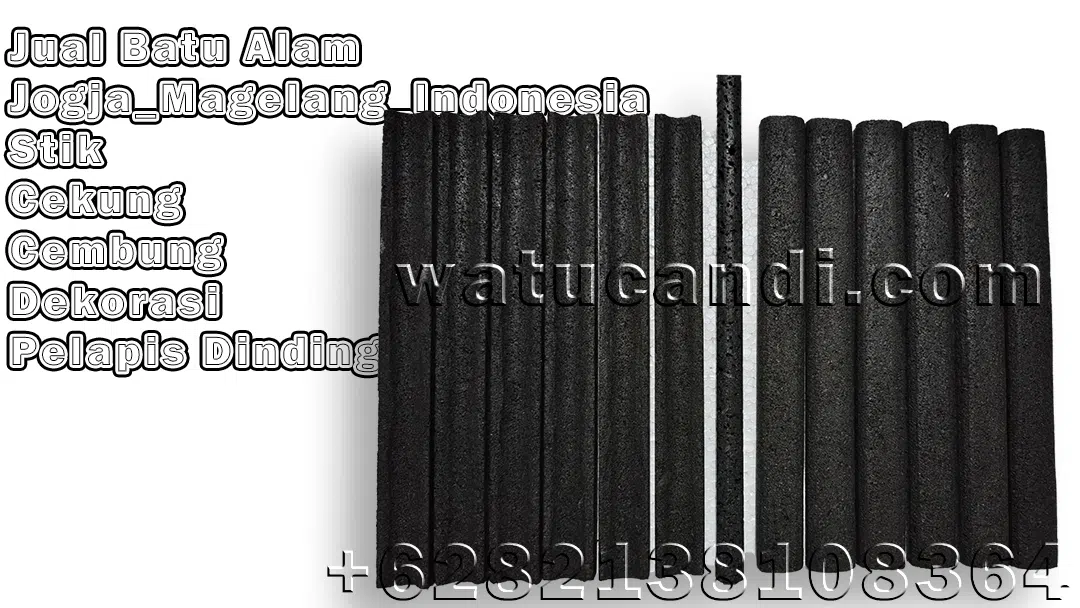
Natural Andesite Stone is a remarkable and robust volcanic rock widely prized in both the construction and decorative arts industries. As an igneous rock formed from the solidification of lava at the Earth’s surface, it offers a unique combination of aesthetic appeal and robust physical properties. This makes it an exceptional choice for cladding walls and flooring applications, suitable for both interior and exterior environments.
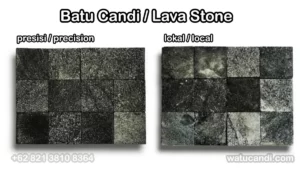
Renowned for its distinctive grey to dark green hues and varied textures, Natural Andesite Stone introduces a natural, earthy element to architectural designs. Its volcanic origins imbue it with inherent strength and resilience against weathering, rendering it highly suitable for demanding applications such as paving, pool surrounds, and structural elements. Understanding its properties and potential uses allows architects, designers, and homeowners to leverage its benefits effectively.
Whether employed for crafting elegant interior spaces or constructing durable outdoor areas, Natural Andesite Stone delivers a timeless and sophisticated finish that harmonizes effortlessly with diverse design styles. Its natural beauty and durability make it a sought-after material for various applications ranging from Javanese Andesite sourced from regions like Yogyakarta and Magelang to projects worldwide.
As a volcanic rock, Andesite is part of a family of stones known for their strength and unique appearance. Explore related materials like Merapi Mountain stone or lava stone for similar properties and applications.
Properties of Andesite Rock
A thorough understanding of the fundamental properties of Andesite Rock is essential for appreciating its broad suitability across diverse applications. As a volcanic igneous rock, its formation process directly influences its physical and chemical characteristics.
Formation
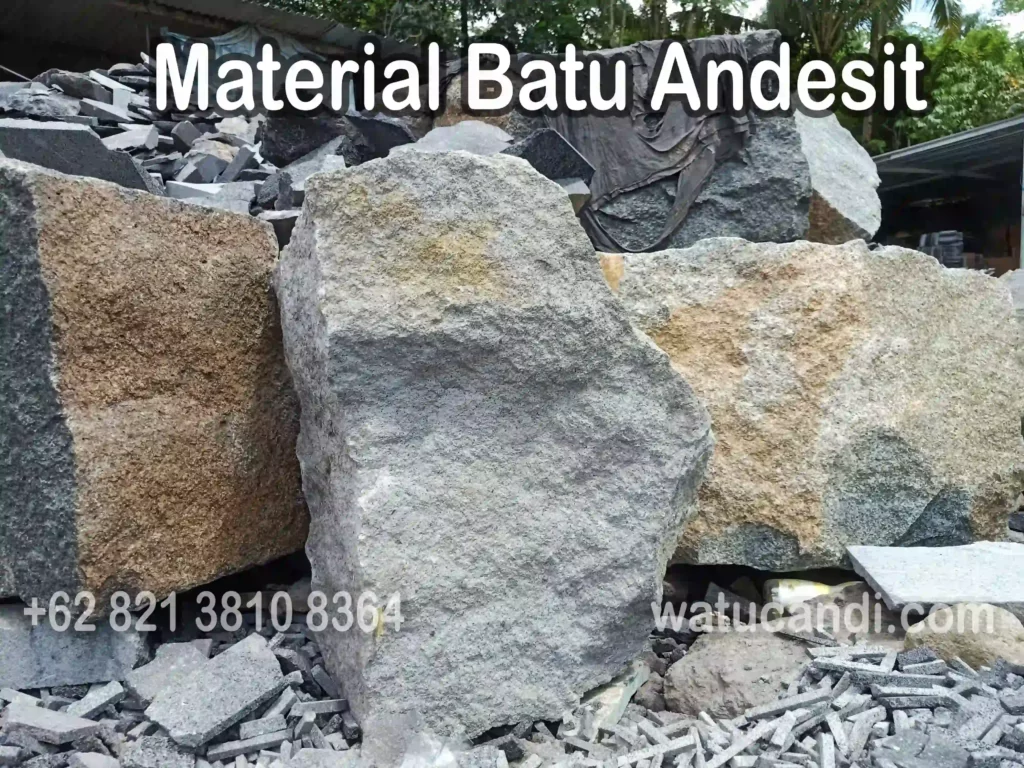
Andesite Rock is classified as an extrusive igneous rock. It originates when intermediate-composition magma (compositionally between basaltic and rhyolitic) erupts onto the Earth’s surface as lava and undergoes relatively rapid cooling. This swift cooling process inhibits the growth of large crystals, leading to a fine-grained texture. The nomenclature ‘andesite’ is derived from the Andes Mountains in South America, where this particular rock type is notably abundant.
This rapid solidification process is what distinguishes it from intrusive igneous rocks like granite, which cool slowly deep within the Earth’s crust, allowing larger crystals to form. The extrusive nature of Andesite contributes significantly to its dense, hard-wearing characteristics, making it ideal for construction and decorative uses.
Composition
The primary mineral constituents defining Andesite Rock include plagioclase feldspar, amphibole (commonly hornblende), and pyroxene. These minerals play a pivotal role in determining its characteristic appearance, color, and mechanical properties. In lesser quantities, quartz or biotite might also be incorporated into the rock’s structure, adding subtle variations.
The proportion and crystallization of these minerals directly influence the stone’s final look. A higher concentration of certain minerals can affect the shade, while the interlocking nature of the crystals provides the rock with its inherent strength and durability.
Color
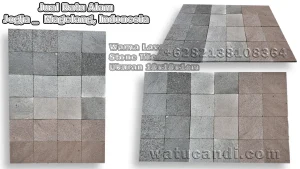
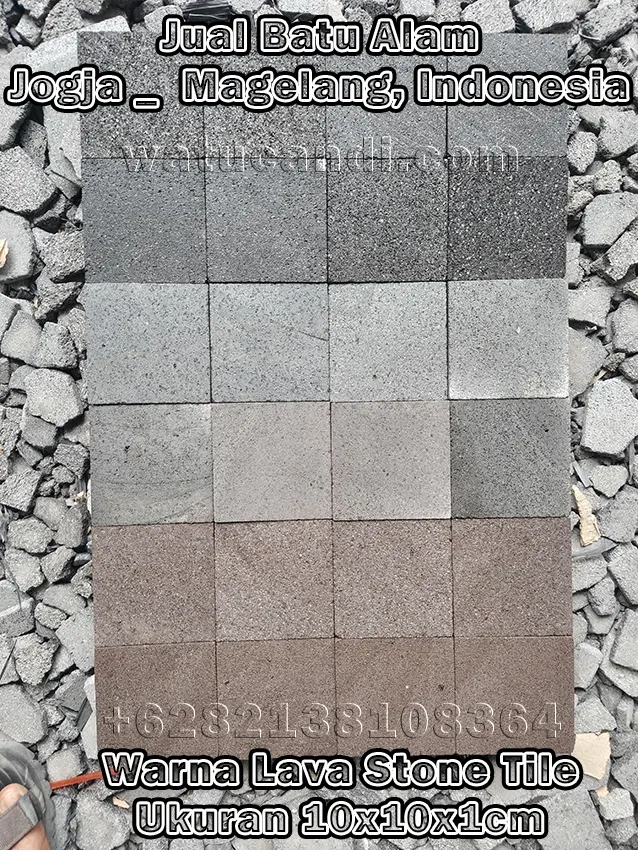
The standard color spectrum for Andesite Rock spans from grey to dark green. However, the specific mineral content and environmental conditions, such as oxidation levels during or after its formation, can introduce variations, including shades of brown or reddish-black. This natural variation not only adds to its visual intrigue and versatility but also allows for unique design possibilities when selecting Andesite from different regions.
These color nuances can be enhanced or altered depending on the surface finish applied, whether it’s a smooth honed look or a rougher, more textured surface.
Texture
Andesite frequently exhibits a porphyritic texture. This distinctive feature is characterized by the presence of larger crystals, typically plagioclase, known as phenocrysts, which are embedded within a finer-grained matrix called the groundmass. This specific texture arises from a two-stage cooling mechanism where initial crystal formation occurs deeper underground before the residual magma erupts and cools rapidly at the surface.
The overall texture can range from smooth to coarse, contingent upon the relative dimensions of the phenocrysts and the fineness of the groundmass. This inherent variability permits the creation of different aesthetic finishes, from a sleek, polished surface to a more rustic, natural look, suiting various application needs.
Other stone textures, such as tumbled or brush hammered, offer alternative aesthetic choices.
Density and Strength
Owing to its volcanic genesis and the considerable pressure encountered during cooling near the Earth’s surface, Andesite Rock typically demonstrates high density and commendable compressive strength. These critical mechanical properties render it eminently suitable for load-bearing applications in construction, including wall cladding, paving stones, and structural components. Its ability to withstand substantial weight and pressure makes it a reliable choice for foundations and heavy-duty surfacing.
This strength is comparable to other robust volcanic stones like lava stone or basalt.
Durability
The inherent hardness and specific chemical composition of Andesite contribute significantly to its outstanding resistance against weathering, abrasion, and impact. This exceptional durability is a principal factor driving its widespread adoption in external applications such as walkways, facades, and pool surrounds, where exposure to environmental elements and wear are persistent concerns.
Its longevity makes it a cost-effective solution in the long term, requiring minimal maintenance compared to less durable materials. Proper care ensures its performance for decades, as detailed in the maintenance section.
Explore durability-focused applications like Merapi lahar stone flooring or rough surface stone floors.
Uses of Natural Andesite Stone
Natural Andesite Stone finds extensive application across multiple sectors due to its exceptional combination of aesthetic appeal, structural strength, and enduring durability. Its versatility allows it to fulfill both functional and decorative roles in numerous settings.
Paving and Flooring
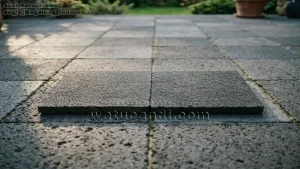
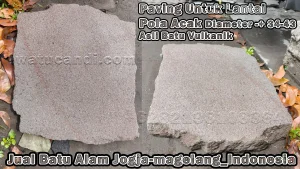
Among the most prevalent applications of Natural Andesite Stone is its utilization for paving and flooring solutions. Its exceptional toughness renders it ideal for outdoor pathways, garden walkways, patios, courtyards, and even driveways. Indoors, it serves effectively for flooring in high-traffic zones, generating a rustic yet sophisticated ambiance. The stone’s natural propensity for slip resistance, particularly when specific finishes are applied, significantly enhances safety in environments prone to moisture.
Its durability makes it suitable for commercial applications as well, such as hotel lobbies, restaurant floors, or public walkways. The natural texture provides traction, reducing the risk of slips and falls.
For more options on outdoor flooring materials, consider exploring outdoor Merapi stone flooring or stones with rough surfaces.
Wall Cladding and Facades
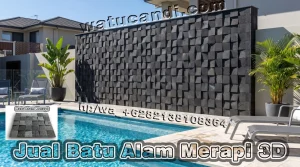
Natural Andesite Stone is highly esteemed for cladding walls, serving both interior and exterior functions. It imparts a robust, natural character to buildings and structures. When used in facades, it provides not only visual appeal but also acts as a protective barrier against weathering agents. The stone’s inherent durability guarantees sustained performance over extended periods while contributing a distinctive architectural element.
It can be used to create feature walls, accent panels, or cover entire building exteriors, offering a modern or traditional look depending on the finish and arrangement.
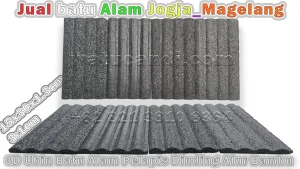
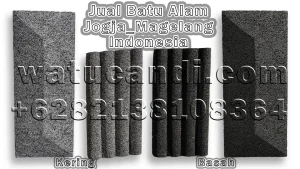
Explore related options like arranged stone slabs or stone edge treatments for different wall effects.
Swimming Pool Areas
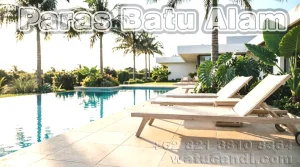
Its superior resistance to water and chemicals, including chlorine, establishes Natural Andesite Stone as a preferred choice for swimming pool decking, coping stones, and lining pool walls and floors. The stone’s natural texture, especially when anti-slip finishes are employed, provides secure footing around pools, enhancing user safety.
The non-porous nature (when sealed appropriately) helps prevent algae growth and staining, maintaining a cleaner appearance.
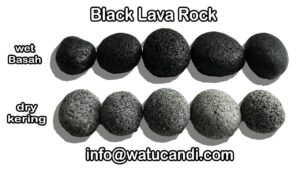
Consider similar materials such as lava stone for pools or black candi lava stone.
Gardens and Landscaping
Within the domain of landscape architecture, Natural Andesite Stone is extensively employed for constructing retaining walls, borders, stepping stones, garden paths, seating areas, small ponds, and decorative features. Its authentic appearance integrates harmoniously with flora and other landscape components, substantially enhancing the overall aesthetic appeal.
It can be used for creating natural-looking rockeries, water features, raised planters, and focal points in gardens. Its durability ensures it withstands outdoor conditions.
Explore materials like authentic layered stones or natural stone slabs for landscaping projects.
Sculpture and Artistic Works
The optimal workability and enduring durability of Natural Andesite Stone establish it as a favored medium for sculptors and artisans. It retains intricate details effectively and withstands outdoor conditions, rendering it apt for creating statues, relief panels, decorative carvings, and architectural ornaments.
Its hardness allows for fine detail work, while its strength ensures the artwork remains intact over time.
Check out handcrafted items like handmade stone baths or stone tables and chairs.
Fencing and Boundary Walls
Natural Andesite Stone furnishes excellent material for constructing fences, boundary walls, and retaining walls. Its inherent strength and weather resistance guarantee long-term stability and minimal maintenance requirements, while simultaneously offering a natural, robust visual appearance.
It creates a sturdy and aesthetically pleasing barrier, suitable for both residential and commercial properties.
Related products include andesite paving stones.
Interior Design Elements
Beyond flooring and walls, Natural Andesite Stone can be incorporated into interior design through feature fireplaces, kitchen backsplashes, bathroom vanities, accent pillars, and custom furniture pieces. Its natural texture and color add depth and character to interior spaces.
Explore ideas in stone and furniture combinations.
Andesite in Java, Indonesia (Yogyakarta, Magelang)
Java, Indonesia, particularly the regions encompassing Yogyakarta (including Kulon Progo, Wates, and adjacent areas) and Magelang, stands out as globally recognized for its substantial deposits of high-grade Natural Andesite Stone. The island’s active volcanic history has generated optimal conditions conducive to the formation of this resilient rock, making it a significant source.
The Andesite extracted from these specific regions enjoys a stellar reputation for its consistent quality, distinctive coloration, and favorable texture. The strategic geographical proximity to major urban centers and the presence of well-established quarrying industries facilitate the ready availability of Javanese Andesite for diverse construction and decorative projects spanning throughout Indonesia and potentially beyond.
Other notable volcanic stone sources in Java include Merapi Mountain stone, Merapi lahar stone, and Borobudur temple stone.
Specific Applications of Javanese Andesite
Paving and Lantai
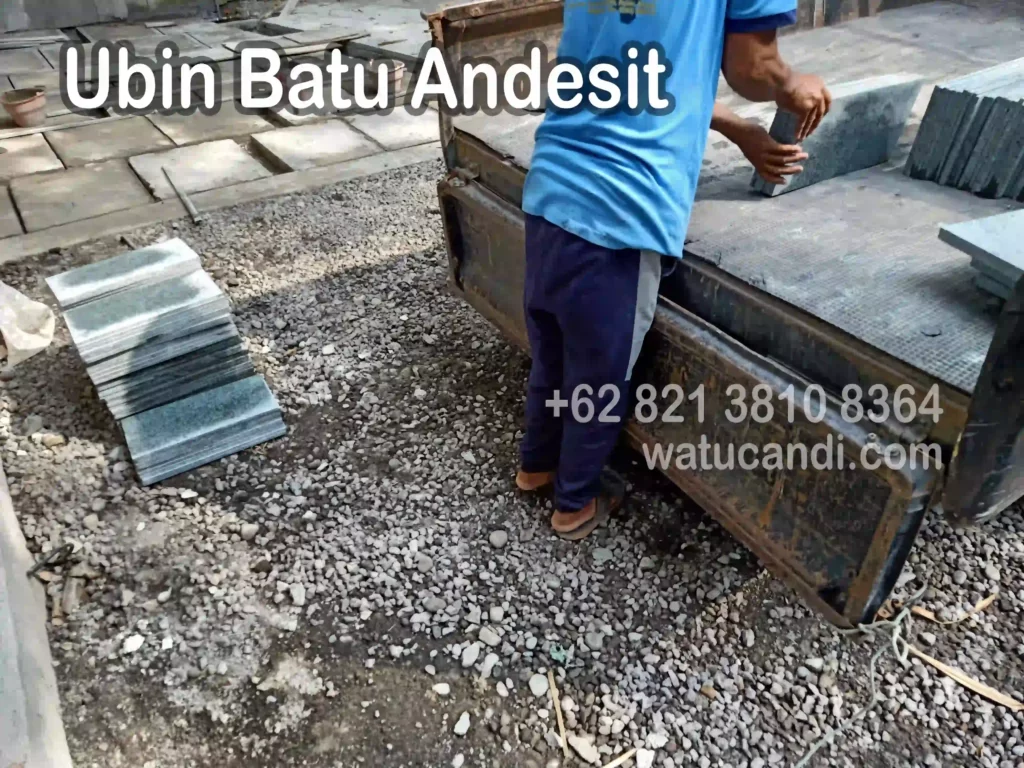
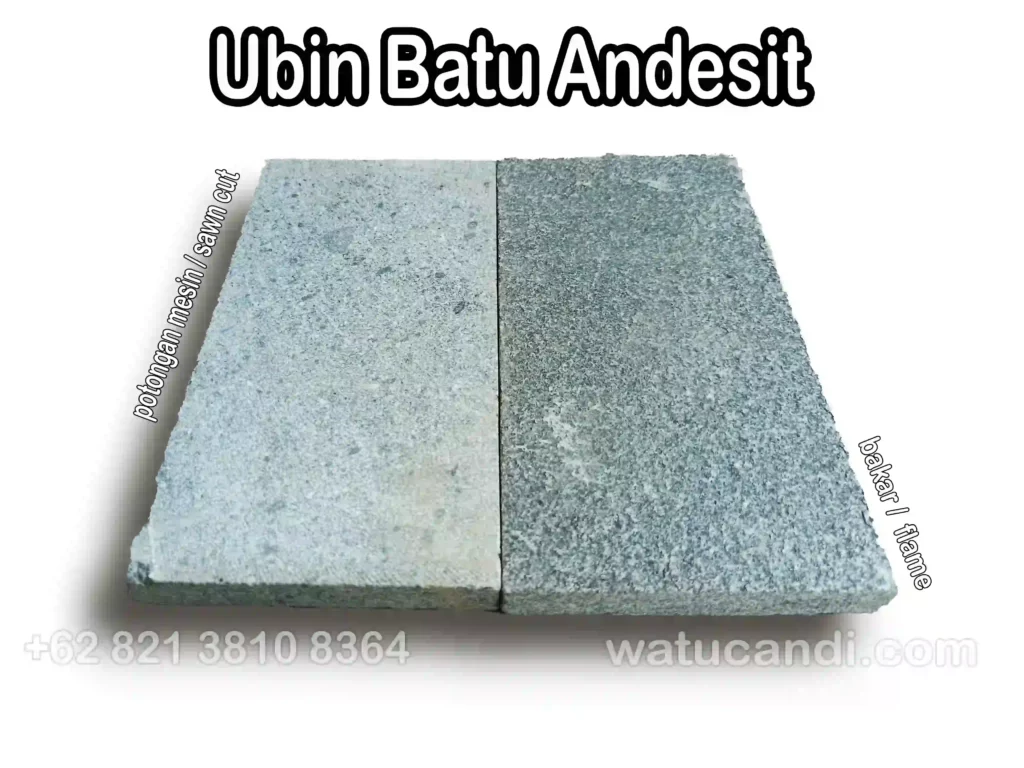
Javanese Andesite is extensively utilized for paving paths, courtyards, and creating durable candi stone walkways and general candi paving floors. Its innate textural qualities provide superior grip, and its inherent durability guarantees longevity under constant foot traffic and fluctuating weather conditions.
Dinding and Building Facades
As cladding for elevating structures or building facades, Javanese Andesite imparts an elegant and natural aesthetic. It significantly enhances the visual appeal of residential homes, commercial edifices, and culturally significant sites.
Kolam Renang
Its resistance to water and chemicals makes it ideal for swimming pool applications, used for pool decks, walls, and floors, providing both functionality and style.
Taman and Landscape
Utilized for creating decorative elements, retaining walls, seating areas, and water features in gardens and public spaces, integrating naturally with the environment.
Patung and Artistic Creations
The stone is favored by artists and craftsmen for creating sculptures, carved panels, and other ornamental pieces due to its workability and durability.
Pagar and Enclosures
Provides sturdy and attractive material for constructing fences, boundary walls, and garden enclosures.
The popularity of Javanese Andesite stems from its proven quality and the rich geological heritage of the region. Sourcing from reputable suppliers ensures authenticity and consistent quality.
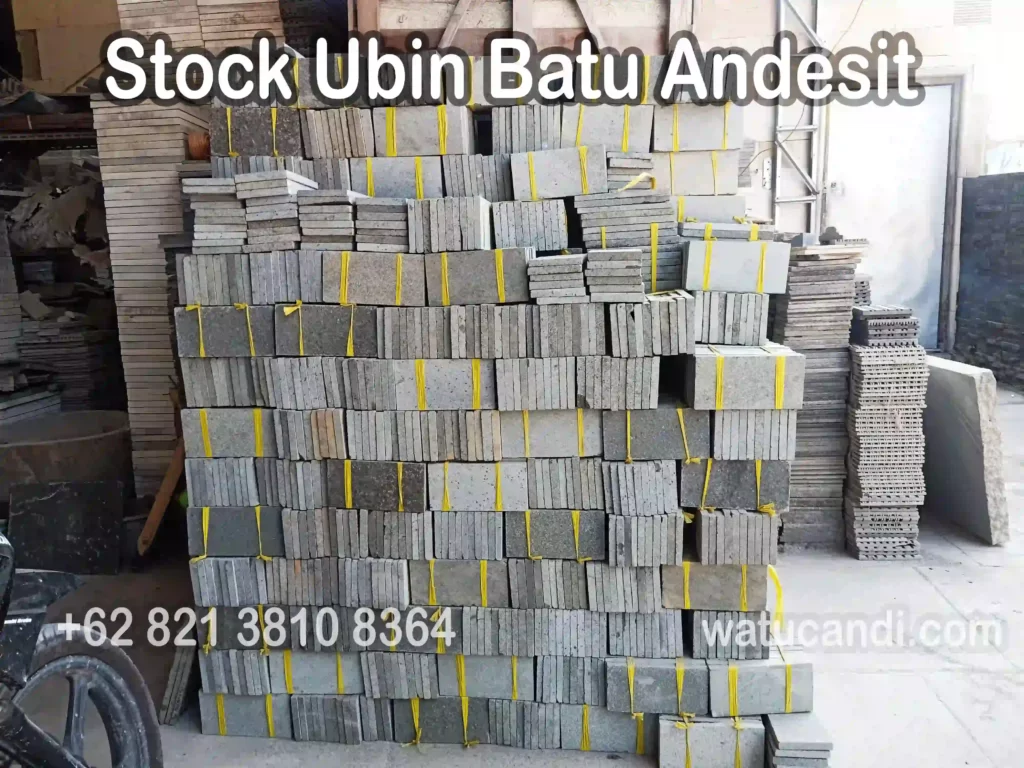
When sourcing Andesite stone, choosing suppliers from regions known for quality, like Yogyakarta and Magelang, is crucial.
Surface Finishes for Andesite
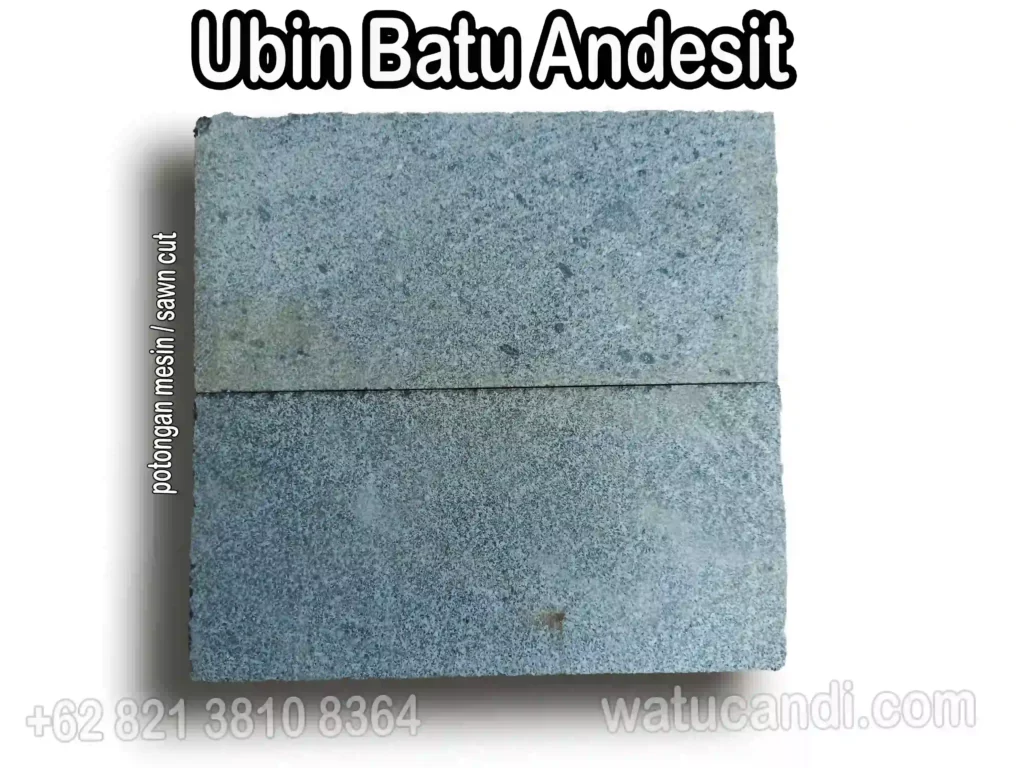
The surface finish applied to Natural Andesite Stone exerts a profound influence on both its visual appearance and functional performance. Distinct finishes provide unique looks and performance attributes, specifically tailored to suit a wide array of applications.
Polished (Berkilap)
This finish involves the meticulous smoothing and buffing of the stone surface to attain a high-gloss, reflective appearance. The polished surface accentuates the stone’s natural colors and patterns, generating an elegant and sophisticated look. It is predominantly selected for interior applications such as living room floors, feature walls, and bathroom vanities where a sleek, modern aesthetic is desired.
While visually appealing, polished surfaces can be more slippery when wet and may show scratches more readily than matte finishes.
Honed (Halus)
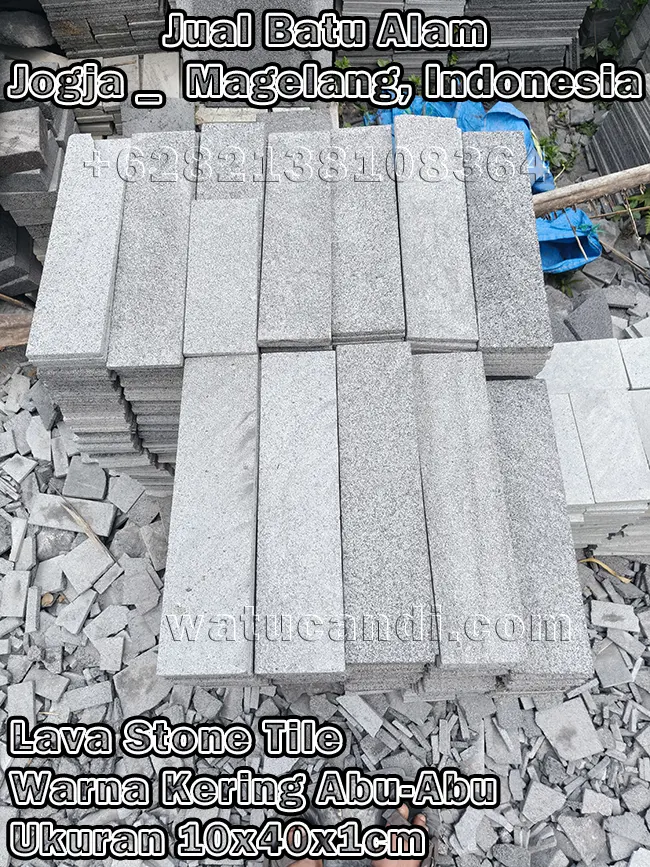
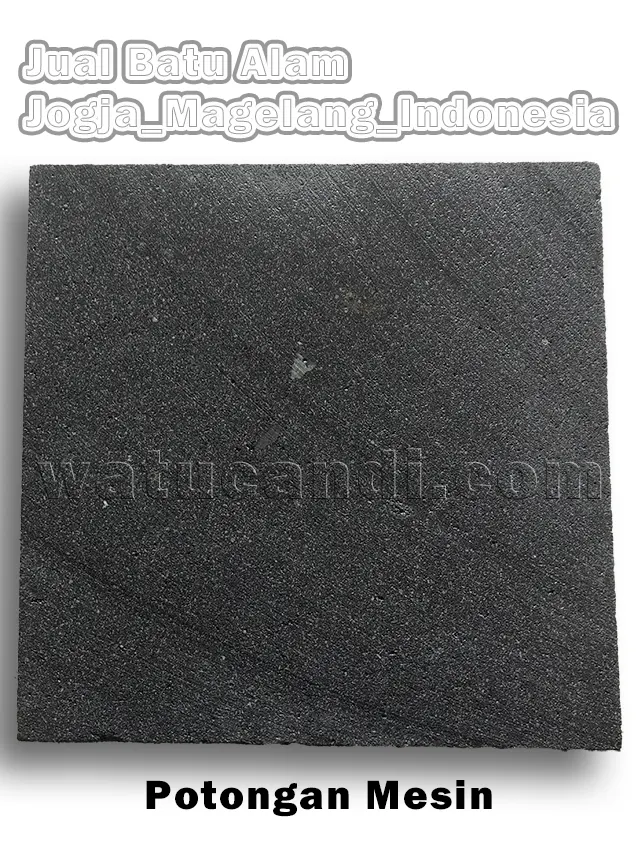
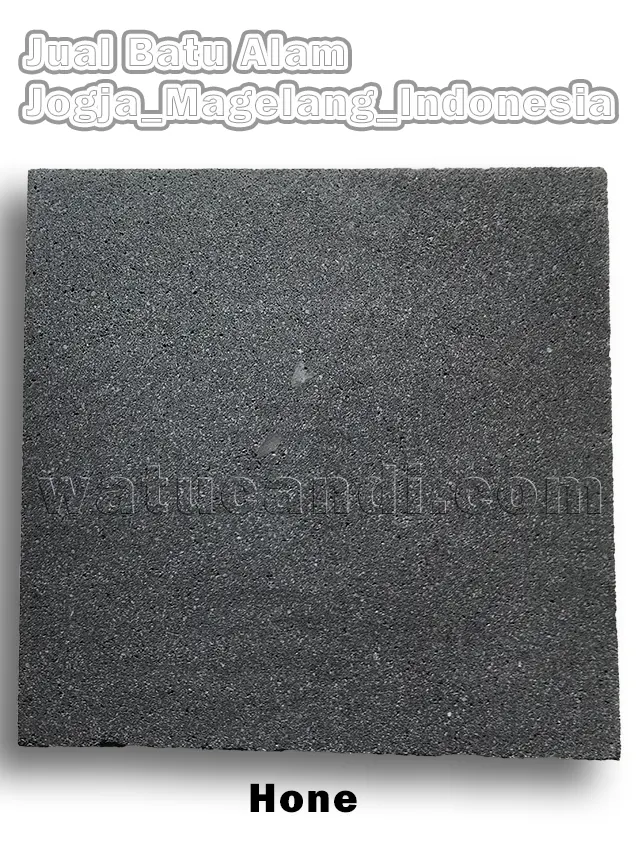
The honed finish delivers a smooth, flat surface, albeit devoid of the high gloss associated with polishing. It presents a more matte, natural appearance while preserving a refined tactile sensation. Honed Andesite demonstrates versatility, proving suitable for both interior and exterior usage, including kitchen floors, entryways, stairs, and outdoor patios. It exhibits reduced slipperiness compared to polished stone and manifests fewer visible scratches.
Honed finishes are often preferred for high-traffic areas or spaces where safety is a concern.
Flamed (Terbakar)
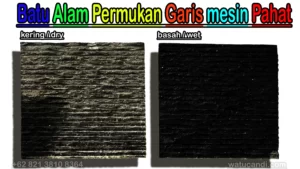
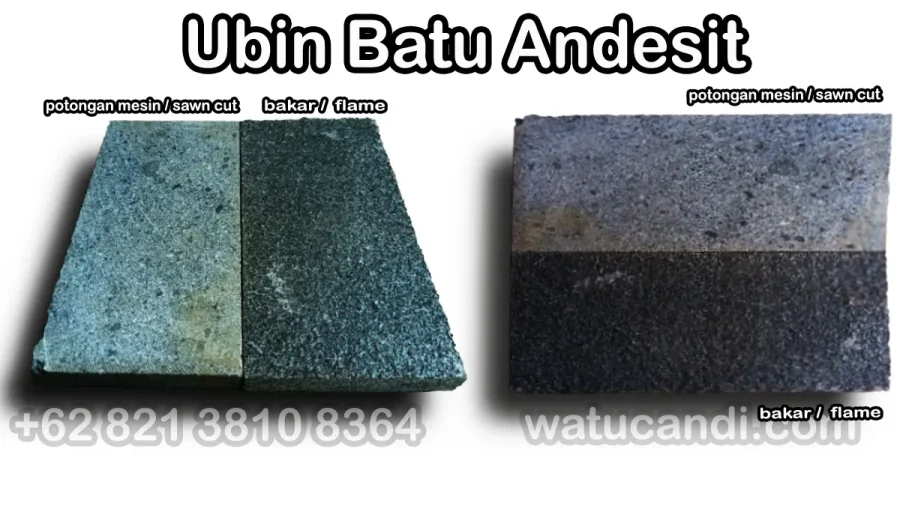
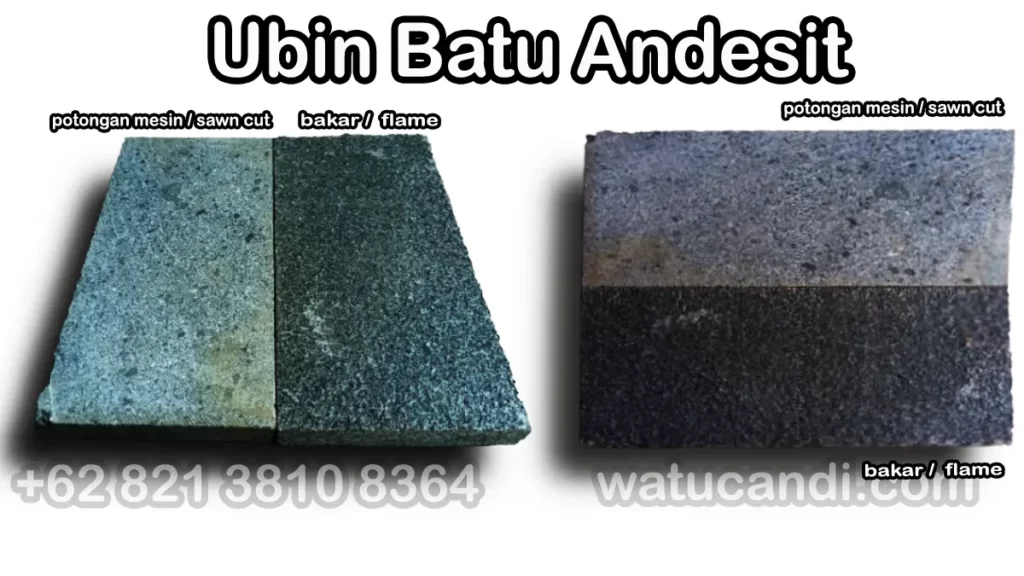
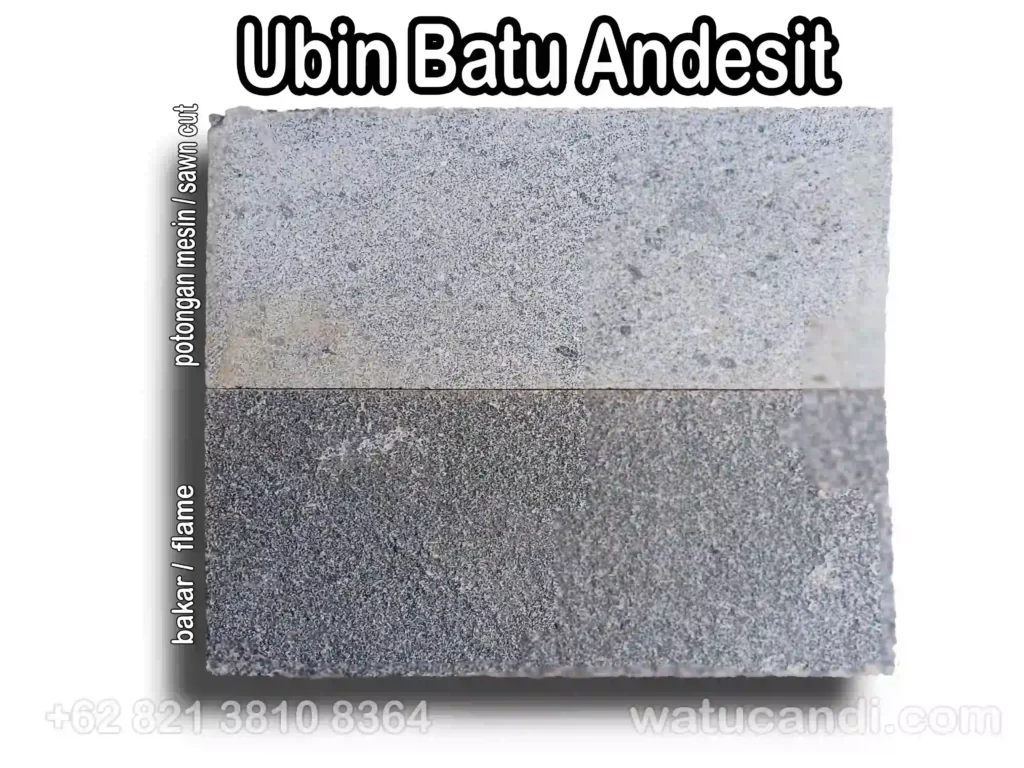
This process entails heating the stone surface with intense heat (flame) and subsequently effecting rapid cooling. This thermal treatment induces the bursting of the top layer, generating a rough, textured surface. The flamed finish delivers excellent slip resistance, rendering it ideal for outdoor areas like garden paths, terraces, pool decks, and zones susceptible to wetness. It also imparts a very natural, rugged aesthetic.
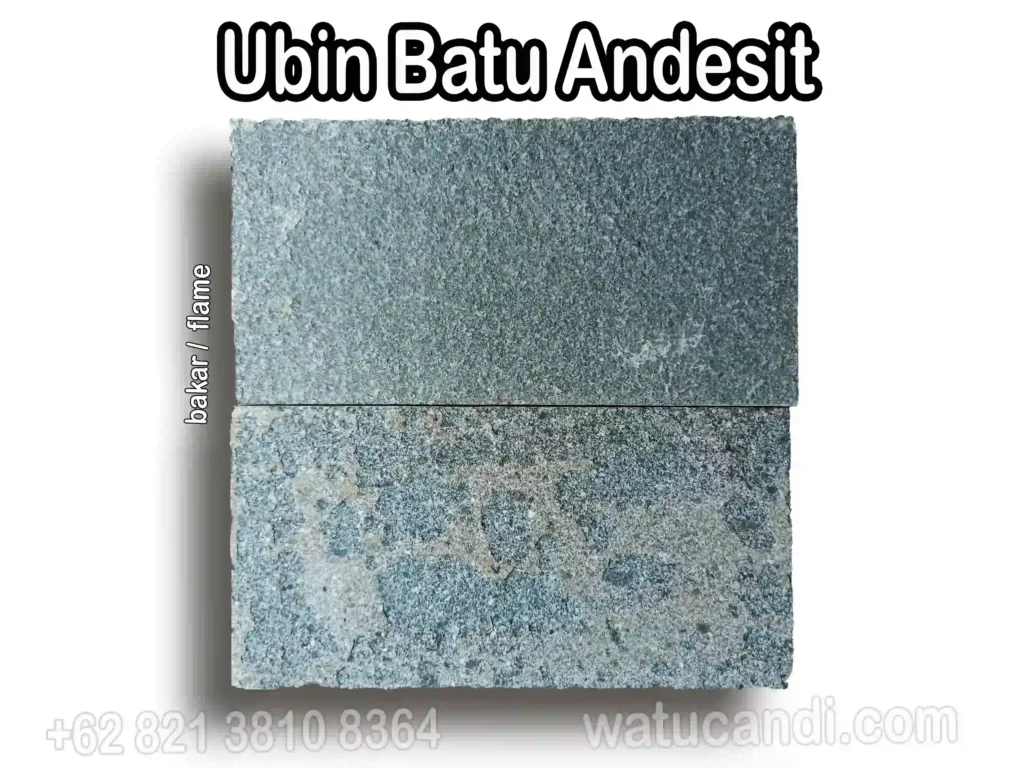
Explore similar textured finishes like brush hammer black lava surface or tumbled finishes.
Brushed (Disikat)
The surface undergoes mechanical brushing utilizing abrasive tools to generate a marginally rougher texture compared to honed, yet smoother than flamed. This finish imparts a subtle texture and a more natural, weathered appearance. Brushed Andesite finds frequent application in outdoor walkways, garden steps, and zones where a balance between aesthetics and grip is required.
It offers a middle ground between the smoothness of honed and the roughness of flamed, providing a pleasant tactile experience.
Split Face (Belah Permukaan)
This finish emulates the natural fracture plane of the stone, generating a rough, uneven surface with visible crystal structure. It is achieved by splitting the stone along its natural grain. Split face Andesite is primarily employed for decorative wall cladding, interior accent walls, or exterior feature walls, offering a very raw, natural appearance.
For similar appearances, consider breccia stone tiles.
Bush Hammered (Cetak Tekan)
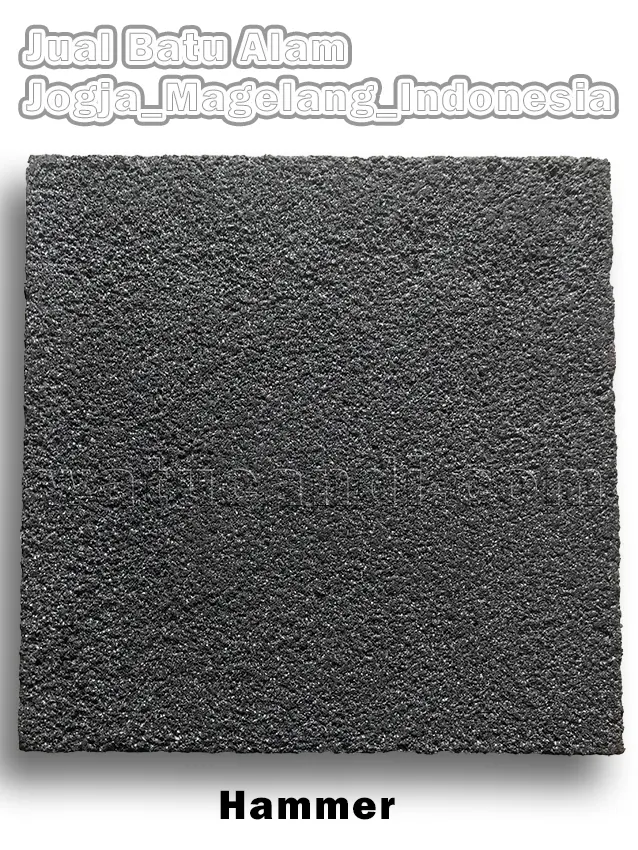
A bush hammer tool is employed to create small, regular indentations across the surface, producing a uniformly textured, non-slip surface. This finish is robust and frequently utilized for industrial or high-traffic areas like factory floors, commercial walkways, steps, or outdoor platforms where safety and durability are paramount.
It provides maximum slip resistance and is often chosen for commercial or public spaces.
Selecting the appropriate surface finish is essential. It should align precisely with the intended function (e.g., slip resistance for wet areas), the desired aesthetic (shiny versus matte), and the location (interior versus exterior). The correct finish enhances both the visual appeal and practical utility of Natural Andesite Stone in any given project.
Consider finishes for other stones like black lava stone tiles or other stone tiles for comparison.
Maintenance and Care of Natural Andesite Stone
Although Natural Andesite Stone inherently possesses durability, implementing appropriate maintenance protocols ensures its longevity and preserves its aesthetic appeal. Proper care extends the life of the installation and maintains its original beauty.
Regular Cleaning
Routine cleaning employing water and a mild detergent typically suffices for routine upkeep. Employ a soft brush or cloth to eliminate accumulated dirt and debris effectively. It is imperative to avoid harsh chemicals or acidic cleaners, which possess the potential to damage the stone’s surface, particularly on polished finishes. Using pH-neutral cleaners is generally safer.
For outdoor applications, power washing on a gentle setting might be necessary periodically.
Sealing
Depending on the specific porosity of the individual stone batch and the finish applied, sealing might be recommended, especially for interior use or areas exposed to potential staining (like kitchens or near pools). Consultation with your supplier regarding the necessity for sealers and the appropriate reapplication schedule is advisable. Sealing helps protect against oil, water, and other stains.
Sealers come in various types, including penetrating sealers and topical coatings, each with specific applications.
Dealing with Stains
It is crucial to address spills promptly to prevent permanent staining. For organic stains, a poultice might be necessary. Always test cleaning methods on a concealed area initially to avoid damaging the visible surface. Professional consultation is recommended for persistent or challenging stains.
Knowing how to properly maintain your purchased stone is just as important as the initial selection.
Buying Natural Andesite Stone
When procuring Natural Andesite Stone, careful consideration of several key factors is paramount to ensure satisfaction with the product and its performance.
- Source: Verification of the origin (e.g., Yogyakarta, Magelang) is essential for ensuring quality consistency and authenticity.
- Quality: Thorough inspection for cracks, chips, uniformity in color and texture (where applicable), and overall structural integrity is vital.
- Finish: Confirmation that the finish aligns precisely with your requirements for both appearance and function is necessary.
- Size and Thickness: Validation that dimensions conform to your project specifications is crucial.
- Supplier Reputation: Selection of trusted suppliers with demonstrated experience, such as those specializing in stone furniture or specialized products, is highly recommended.
- Price and Availability: Obtaining quotes from multiple suppliers and checking stock levels ensures competitive pricing and timely delivery.
- Certifications: If required for specific projects, ensure the supplier can provide relevant quality certifications.
Always request samples whenever possible to accurately assess color, texture, and finish suitability before committing to a large purchase. Suppliers often provide valuable information regarding care and installation best practices, which is essential for long-term satisfaction.
Explore related stone types such as brown sandstone, Sukabumi green stone, or Palimanan paras stone for comparison and alternative options.
Frequently Asked Questions (FAQs)
Is Natural Andesite Stone expensive?
The cost varies based on factors like source, quality, finish, thickness, and quantity required. Generally, it is considered a mid-range to premium natural stone option, offering good value considering its durability and aesthetic appeal. Prices can fluctuate based on market demand and supply chain factors.
Compared to other natural stones, Andesite often provides a balance between cost and performance. Materials like black lava stone or black lava tiles may have different price points.
Is Andesite suitable for indoor flooring?
Yes, especially when finished appropriately (like honed or polished). It’s durable and adds a unique, natural look to interiors. Consider the slip resistance of the chosen finish, particularly in wet areas like bathrooms. Proper sealing indoors can enhance stain resistance.
How does Andesite compare to Basalt?
Both are volcanic rocks, but they differ in composition and appearance. Basalt is usually darker (black/grey) and denser than Andesite (which is often grey/green). They share similar strength and durability characteristics. Both are excellent choices for demanding applications.
Compare with products like black basalt sinks.
Can I install Andesite myself?
While DIY installation is possible for simple projects (like small pathways), professional installation is strongly recommended for complex layouts, large areas, or structural applications to ensure proper fitting, support, and longevity. Proper subfloor preparation and adhesive selection are critical.
What are common sizes available for Andesite tiles/slabs?
Standard sizes vary by supplier but commonly include various thicknesses (e.g., 1cm, 2cm, 3cm) and formats like 30x30cm, 60x30cm, 60x60cm, or custom cuts. Larger slabs are also available for specific applications like wall cladding or countertops.
For specific products, check options like black lava stone tiles or other stone tiles.
Is Andesite suitable for high-traffic areas?
Yes, due to its high density and hardness, Andesite is excellent for high-traffic areas. The choice of finish affects slip resistance; honed or flamed finishes are often better for areas with foot traffic, especially outdoors.
How do I clean Andesite outdoors?
Outdoor Andesite can be cleaned with water and a mild detergent. A pressure washer on a low setting can be used for stubborn dirt. Avoid harsh chemicals. Regular cleaning helps maintain its appearance and prevents moss or algae buildup.
For further exploration of volcanic stone applications, see lava stone exterior design, lava stone flooring, or Merapi lava decking.
Comparing Andesite with Other Stones
Understanding how Natural Andesite Stone compares to other popular natural stones helps in making informed decisions for specific projects.
Andesite vs. Granite
Granite is an intrusive igneous rock, formed deep underground, resulting in larger crystals and often a more varied color palette with distinct speckles. It is generally harder than Andesite. Andesite, being extrusive, has a finer grain and often a more uniform color tone. Both are durable, but granite is often chosen for kitchen countertops due to its lower porosity, while Andesite is favored for its unique texture and volcanic origin.
Andesite vs. Limestone
Limestone is a sedimentary rock, typically softer and more porous than Andesite. It often comes in lighter colors (white, beige, grey) and can be more susceptible to acid etching. Andesite is much harder and more weather-resistant, making it superior for exterior applications and high-wear areas compared to limestone.
Explore lava-based alternatives for similar performance.
Andesite vs. Sandstone
Sandstone is another sedimentary rock, composed of sand-sized grains. It is generally softer and more porous than Andesite. Sandstone often has a more granular feel and comes in various colors influenced by mineral content (e.g., brown sandstone). Andesite offers superior strength and durability for structural applications.
Design Ideas with Andesite
Incorporating Natural Andesite Stone into design projects opens up numerous creative possibilities.
Modern Minimalist Interiors
Use honed or polished Andesite for clean-lined flooring or accent walls to create a sleek, contemporary look. The neutral grey tones complement minimalist furniture and lighting.
Rustic Outdoor Spaces
Employ flamed or split-face Andesite for patios, garden paths, or retaining walls to achieve a rugged, natural aesthetic. Combining it with wood elements creates a warm, inviting atmosphere.
Consider similar volcanic stones for cohesive landscaping.
Feature Walls
Create striking interior or exterior feature walls using split-face or bush-hammered Andesite to add texture and visual interest to a room or facade.
Pool and Spa Surrounds
Utilize flamed or brushed Andesite around pools and spas for its natural anti-slip properties and resistance to chlorinated water, providing both safety and style.
Explore lava stone options for pools as well.
These design concepts highlight the versatility of Natural Andesite Stone across various contexts, from functional applications to aesthetic enhancements, demonstrating its value as a premier building and decorative material.
Tags: natural andesite stone, andesite rock properties, andesite stone uses, andesite java indonesia, andesite yogyakarta, andesite magelang, andesite surface finishes, andesite maintenance, buying andesite stone, andesite FAQs, andesite vs other stones, andesite design ideas, javanese andesite, yogyakarta andesite, polished andesite, honed andesite, flamed andesite, brushed andesite, split face andesite, bush hammered andesite, andesite flooring, andesite paving, andesite wall cladding, andesite landscaping, andesite pool surround, volcanic rock andesite, igneous rock andesite, andesite supplier, caring for andesite,