


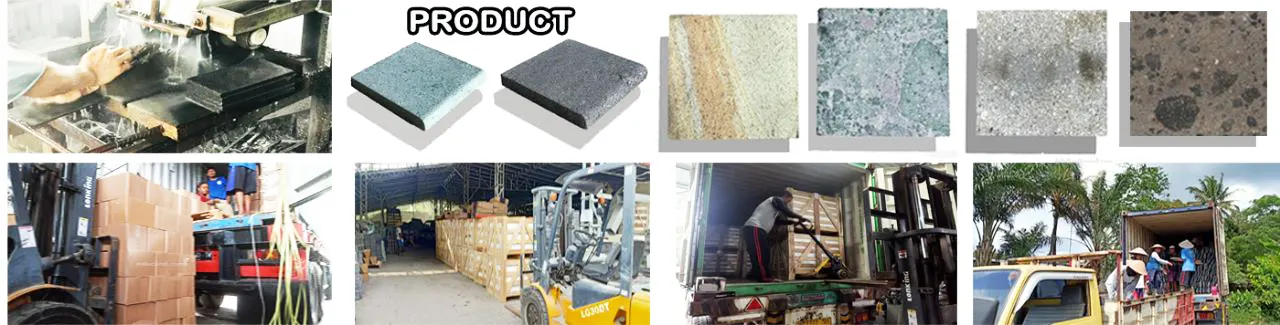
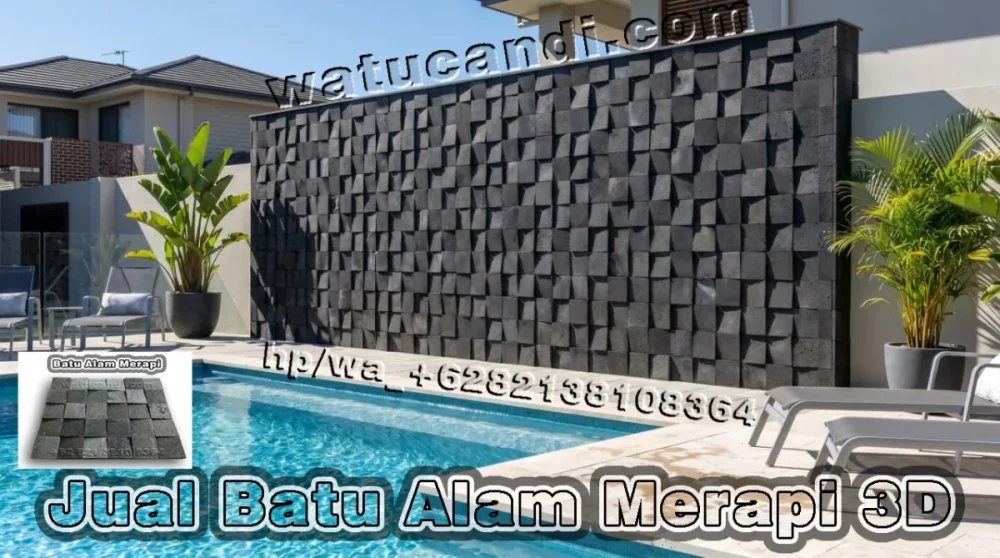
Our premium 3D stone slabs are crafted from authentic Indonesian volcanic rock, sourced from the legendary Mount Merapi. These hand-carved 3D lava stone panels offer stunning depth, texture, and timeless elegance for interior and exterior applications. Perfect for feature walls, lobby interiors, resort villas, and luxury commercial spaces, each slab features a unique three-dimensional surface inspired by the natural contours of volcanic formations. Available in various sizes and finishes, our 3D natural stone slabs bring the raw beauty of nature into any space, creating dramatic visual impact and lasting durability.
3D Stone Slabs – Table of Contents:
- 1. Introduction: Volcanic Heritage and Nusantara Aesthetics
- 2. Geology and Characteristics of Merapi Lava Stone
- 3. Technical Specifications of 10×10 cm Dual Thickness Product
- 4. Precision Cutting Technology for Thick-Thin Slabs
- 5. Light Effect on 3D Merapi Stone Artistic Wall
- 6. Temple Stone vs Lava Stone: Understanding the Differences
- 7. Architectural Applications and Interior Design
- 8. Various Benefits and Practical Applications
- 9. Placement Recommendations in Various Spaces
- 10. Complete Installation Guide
- 11. Long-term Care and Maintenance
- 12. Economic Aspects and Property Investment Value
- 13. Sustainability, Environment, and Social Impact
- 14. Conclusion and Final Recommendations
1. Introduction: Volcanic Heritage and Nusantara Aesthetics
Indonesia, as a country located on the Pacific Ring of Fire, is blessed with unparalleled geological wealth. Among the hundreds of volcanoes stretching from Sumatra to Papua, Mount Merapi in Central Java holds a very special position. Etymologically, “Merapi” comes from the words “Meru” (mountain) and “Api” (fire), which literally means “Mountain of Fire”. However, beyond its geological aspects, Merapi has deep philosophical and spiritual meaning for the Javanese people.
This creative power produces the most precious natural material: volcanic natural stone. Every eruption and lava flow from Merapi not only brings threats, but also enriches the soil and leaves deposits of hard material that are then processed into high-quality lava stone.
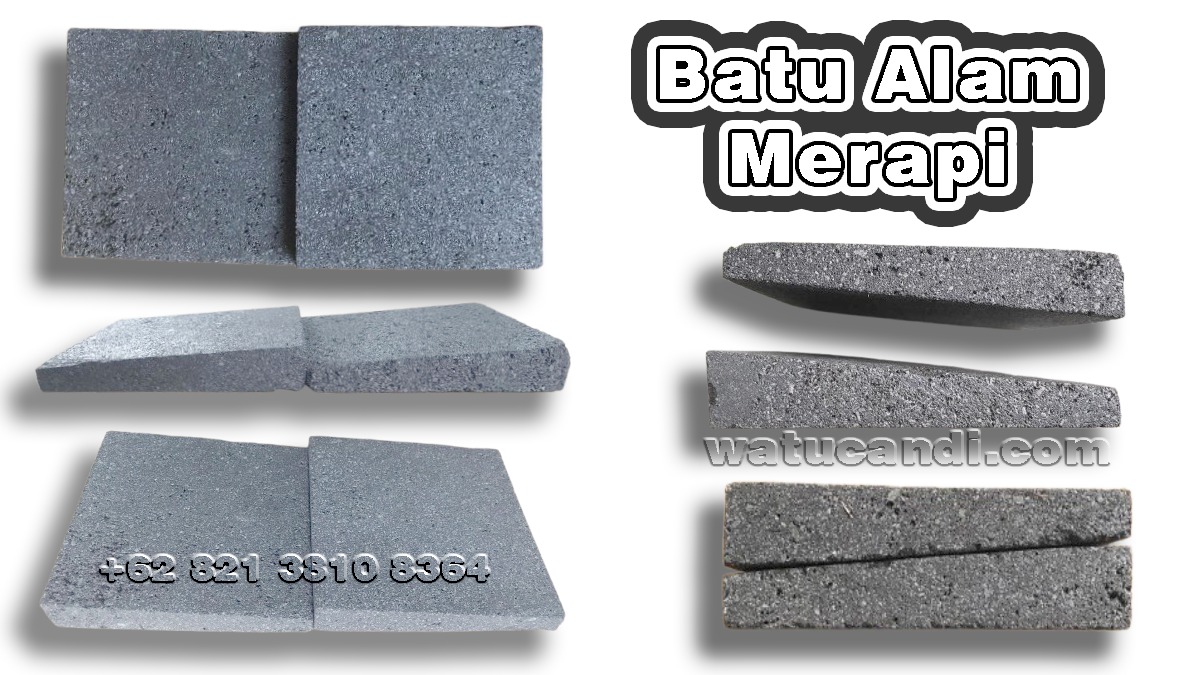
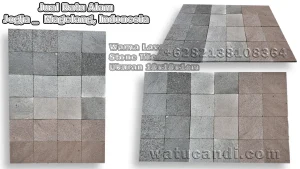
Characterful wall cladding materials are now easier to find. One of them is 3D Merapi natural stone slabs that we produce with precision cuts of 100×100 mm and varying thickness: 20 mm on one side and 10 mm on the other.
The result: the wall is no longer flat; it displays a three-dimensional texture that “lives” through the play of light and shadow.
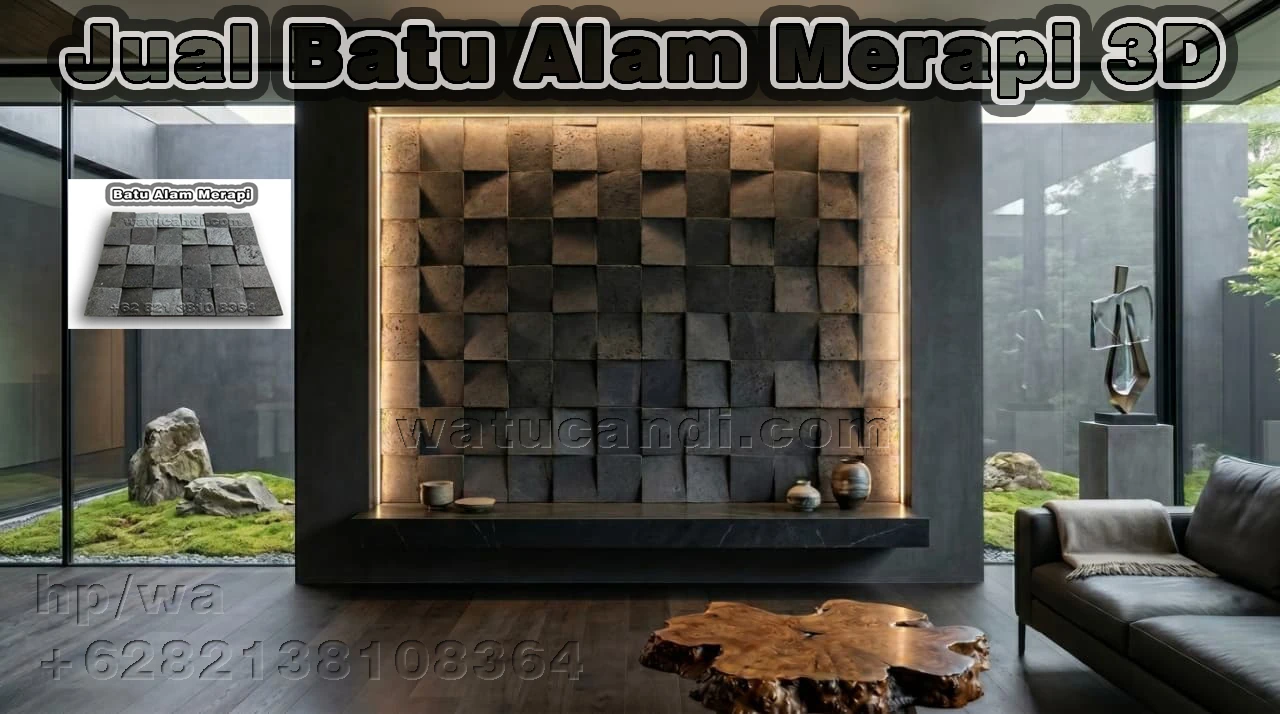
Its main excellence lies in the dramatic light-and-dark visual effect when a light beam touches the surface. The more raised areas catch the light, while the thinner areas are covered in shadow. In other words, the wall transforms into a dynamic canvas throughout the day.
See other natural stone wall varieties here or also read about other natural stones on this site.
2. Geology and Characteristics of Merapi Lava Stone
Mineralogical Composition of Lava Stone
We directly source andesite and basalt from the Mount Merapi area. To understand why natural stone from Merapi is so special, we must explore its mineralogical composition.
The main composition of this black stone includes:
- Plagioclase Feldspar: Provides the base color from gray to deep black.
- Pyroxene and Hornblende: Dark minerals that strengthen the black color and provide hardness to the stone.
- Olivine: Sometimes found in small amounts, providing a slight natural shine.
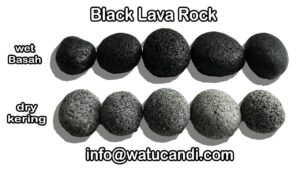
- Vesicles (Air Pockets): The hallmark of lava stone is the presence of small pores formed because gas is trapped when magma cools rapidly.
First of all, this material has high density and minimal pores. Therefore, it is strong, weather-resistant, and not easily cracked. In addition, its natural dark gray color appears elegant thanks to unique feldspar or quartz mineral specks on every piece.
Furthermore, its resistance to water, heat, and moss makes it ideal for damp and semi-outdoor areas. Equally important, there is no artificial coloring – everything is pure natural aesthetics.
Formation Process of Black Stone (Pedra Hitam)
The formation process of pedra hitam (a term often used in export and design markets to refer to volcanic black stone) begins inside the Merapi magma chamber. When an eruption occurs, liquid lava with temperatures reaching 1,000°C to 1,200°C flows down the mountain slopes.
When this lava comes into contact with cooler air or water, the freezing process occurs very quickly (quenching). This rapid freezing prevents the formation of large mineral crystals, resulting in a fine but porous rock structure (aphanitic). The deep black color of lava stone comes from its high mafic mineral content (magnesium and iron).
Physical and Mechanical Properties of Natural Stone
Density and Porosity: Merapi natural stone has an average density between 2,800 to 3,000 kg/m³, making it a very solid and heavy material. However, the presence of vesicles (pores) provides a certain level of porosity that allows the stone to “breathe”.
Compressive and Tensile Strength: As a volcanic material, temple stone from Merapi has very high compressive strength, often exceeding 100 MPa (Megapascal).
Resistance to Weather and Corrosion: One of the absolute advantages of lava stone is its resistance to natural elements. This black stone is resistant to UV rays, acid rain, extreme temperature changes, and frost.
3. Technical Specifications of 10×10 cm Dual Thickness Product
The product discussed in this article has a precision size of 10×10 cm. This size was chosen because it is the golden ratio in architectural modules. The 10×10 cm size is large enough to display the natural texture of natural stone, yet small enough to allow installation on walls with curves, columns, or areas with intricate details.
The cutting process of temple stone into 10×10 cm sizes is done using high-tech stone cutting machines (such as waterjet or diamond wire saw) to ensure straight and precise edges.
Asymmetric Thickness Concept (1 cm and 2 cm)
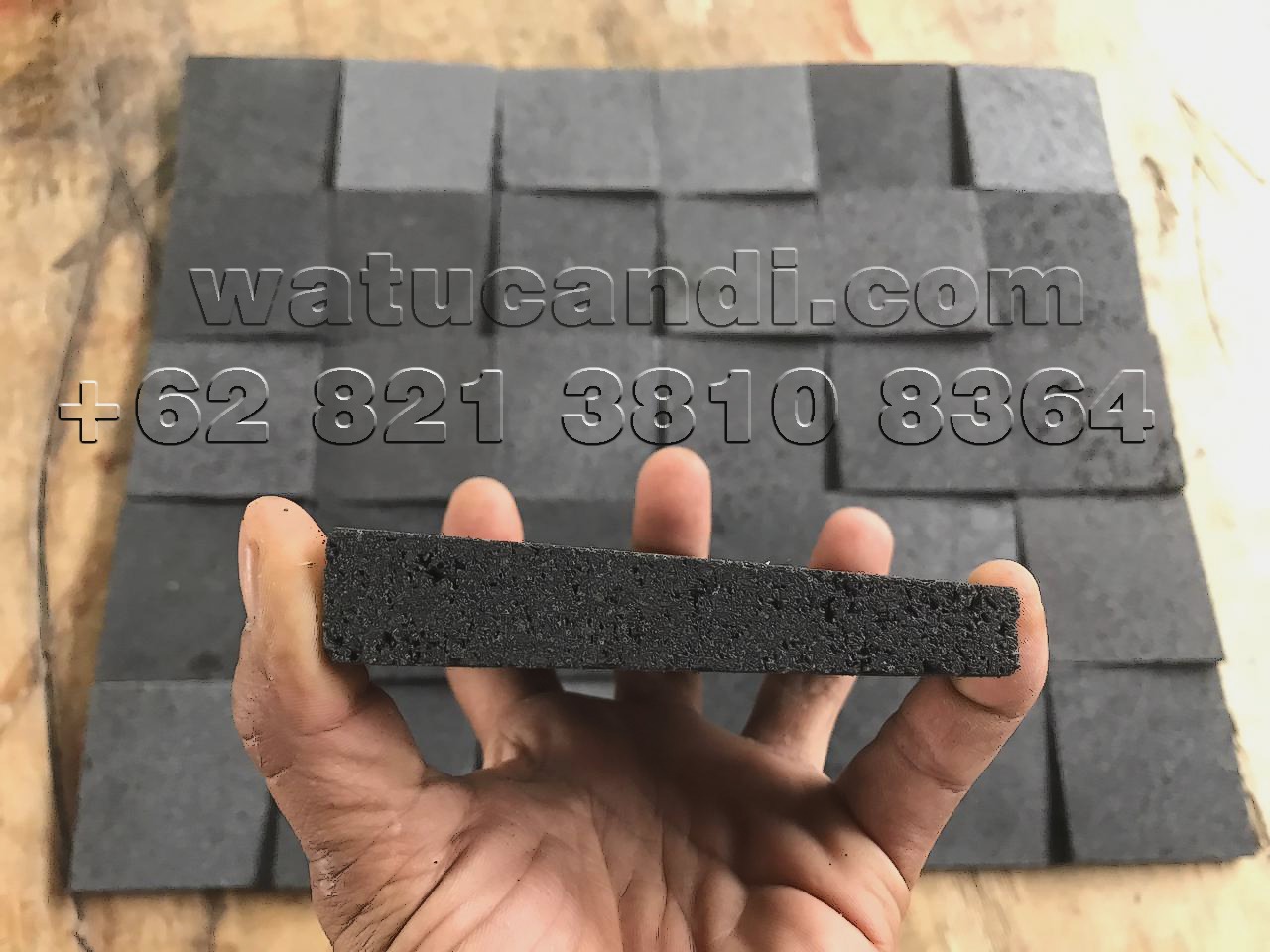
The most interesting innovation of this product is the dual thickness design. Each piece of black stone does not have uniform thickness; one side has a thickness of 1 cm, while the opposite side has a thickness of 2 cm.
Visual Impact of Dual Thickness: This asymmetric thickness creates a dynamic three-dimensional (3D) effect when installed. When sunlight or interior lighting illuminates the wall coated with this lava stone, the difference in thickness will create dramatic shadows (shadow play).
Structural Advantages of 3D Design: Besides aesthetics, the thickness variation of 1 cm and 2 cm also has structural benefits. This variation helps in disguising unevenness of the base wall surface.
4. Precision Cutting Technology for Thick-Thin Slabs
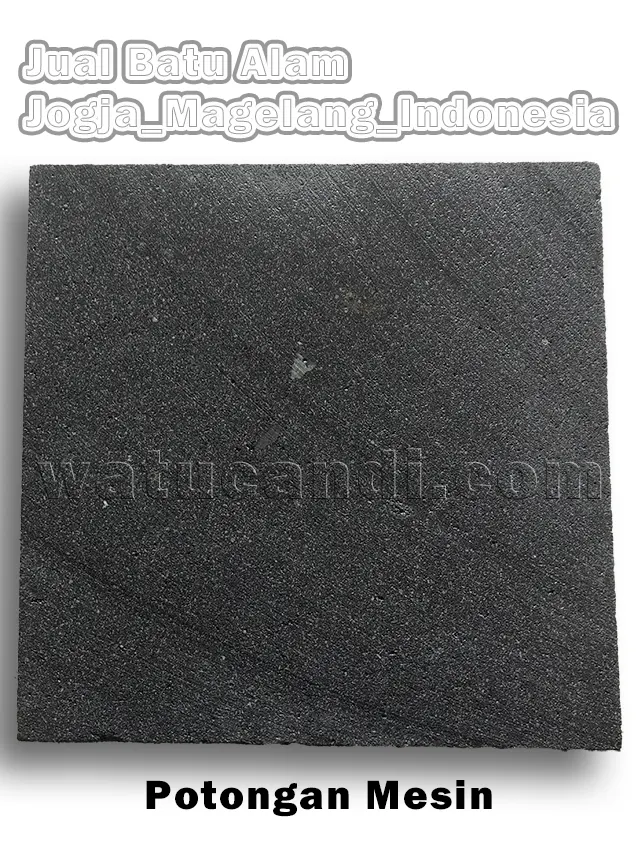
A diamond saw machine cuts the stone into 100×100 mm squares with a tolerance of ±2mm. As a result, the front surface becomes smooth yet non-glossy, so the original pores of the stone remain visible.
Next, a special machine setting creates a slanted cross-section: from a 20 mm edge smoothly tapering to 10 mm. Thus, each piece becomes a miniature trapezoidal prism ready to deliver a three-dimensional effect.
5. Light Effect on 3D Merapi Stone Artistic Wall
An arrangement of tiles that combines thick and thin orientations will form an uneven wall topography. When a spotlight shines from the side (grazing light), the thick side catches bright light, while the thin side sinks into deep shadow.
As a result, a linear gradient is created that changes throughout the day. Even more, this effect cannot be imitated by molded tiles or texture paint. For this reason, the wall appears as an artistic canvas that always looks different depending on viewing angle and time.
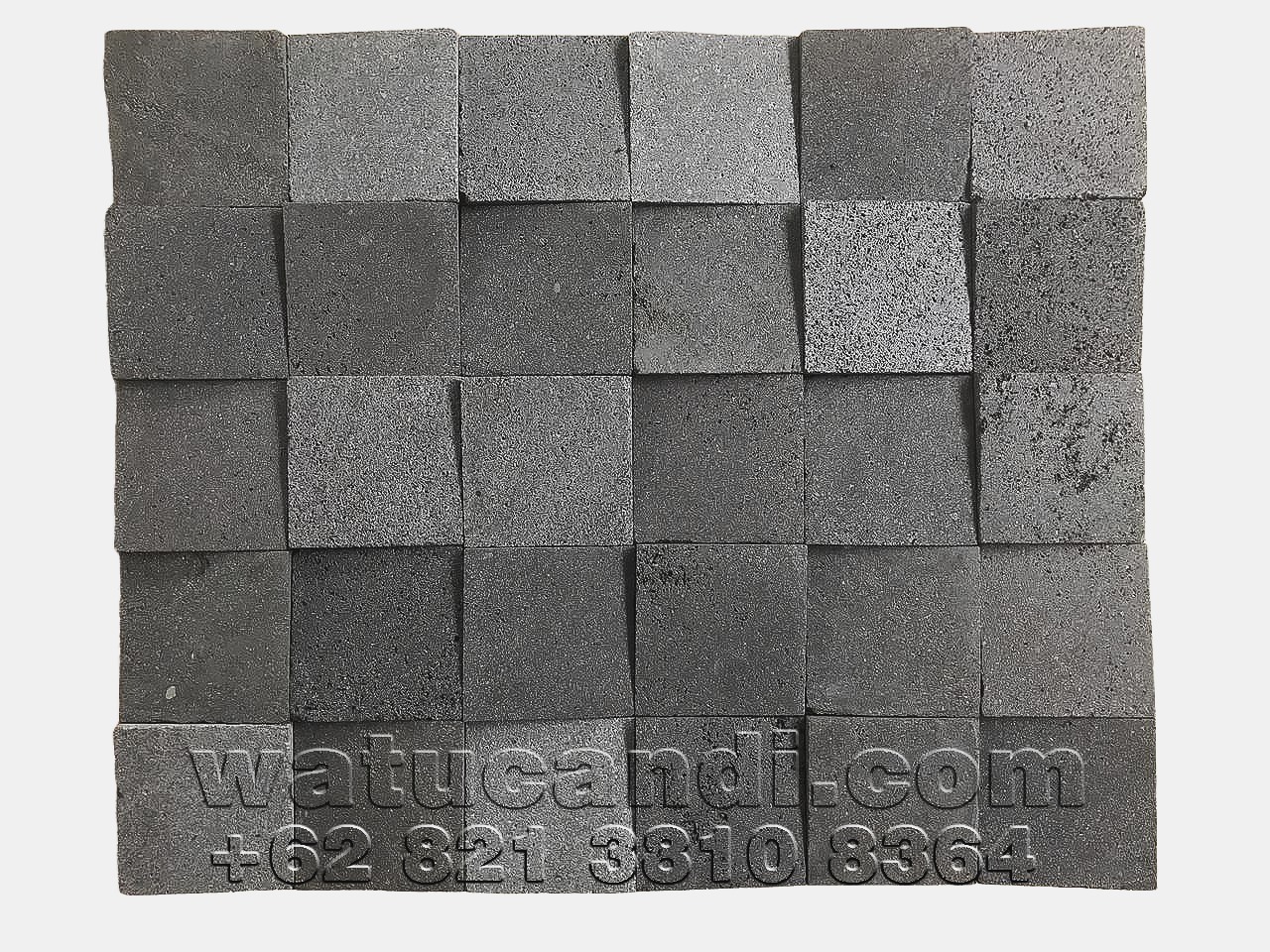
A Closer Look: Five Viewpoints of the Merapi 3D Stone Slab
Here are the visual details from the five available images:
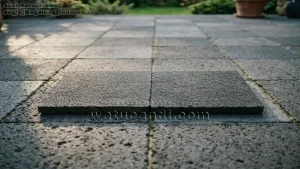
- Front View of a Single Sheet – Shows the smooth sawn surface, natural pores, and the height difference that forms the slope.
- Side View (Profile) – A close-up of the cross-section confirming the seamless transition from 20 mm to 10 mm thickness.
- Wall Arrangement with Side Lighting – Displays the most dramatic scene: thick sides bright, thin sides dark, producing a three-dimensional pattern.
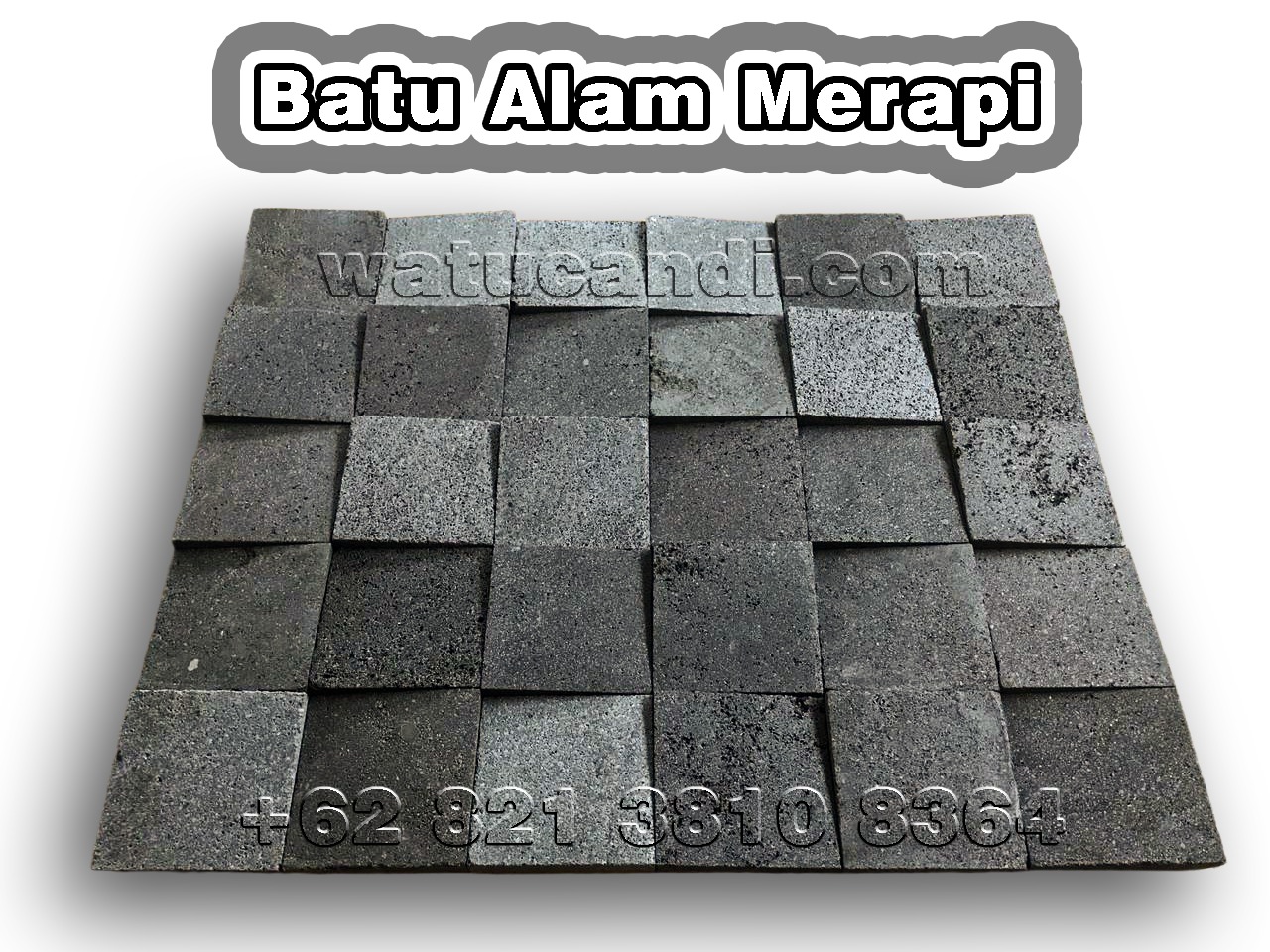
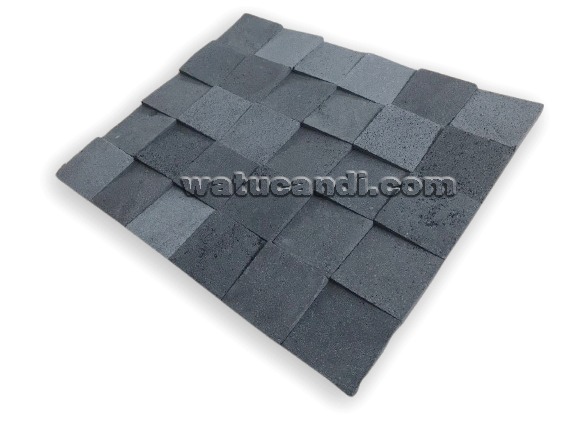
- 45-Degree Angle of Product Stack – Shows the height variation when several pieces are stacked, like a three-dimensional puzzle.
- Real Room Application (Accent Wall) – Shows this material as an accent wall in a modern living room paired with an LED grazing strip.
6. Temple Stone vs Lava Stone: Understanding Differences and Similarities
Definition and Origin of Temple Stone
The term “temple stone” traditionally refers to andesite or volcanic tuff used to build temples in Java. This stone is identical to dark gray to black color, fine yet porous texture, and ease of carving.
Unique Characteristics of Merapi Lava Stone
Meanwhile, “lava stone” is a more specific geological term. It refers to stone formed directly from frozen lava flows. Lava stone from Merapi tends to be harder, denser, and has a deeper black color compared to tuff stone.
Why These Two Terms Often Overlap
In the building materials industry in Indonesia, both terms are often used interchangeably. This 10×10 cm product can be classified as both: it has the aesthetics and historical nuances of temple stone, but in material it is pure lava stone from Mount Merapi. In the international market, this material is often exported under the name lava stone or pedra hitam.
7. Architectural Applications and Interior Design
Use as Wall Cladding
Exterior Walls and Building Facades: The use of natural stone on exterior facades provides a strong architectural statement. Black stone from Merapi, with a thickness of 1-2 cm, gives a sturdy, masculine impression and blends with nature.
Interior Walls and Feature Walls: Indoors, temple stone is often used as a feature wall or accent wall. Walls behind televisions, behind headboards, or dining room walls can be coated with this lava stone to create a dramatic focal point.
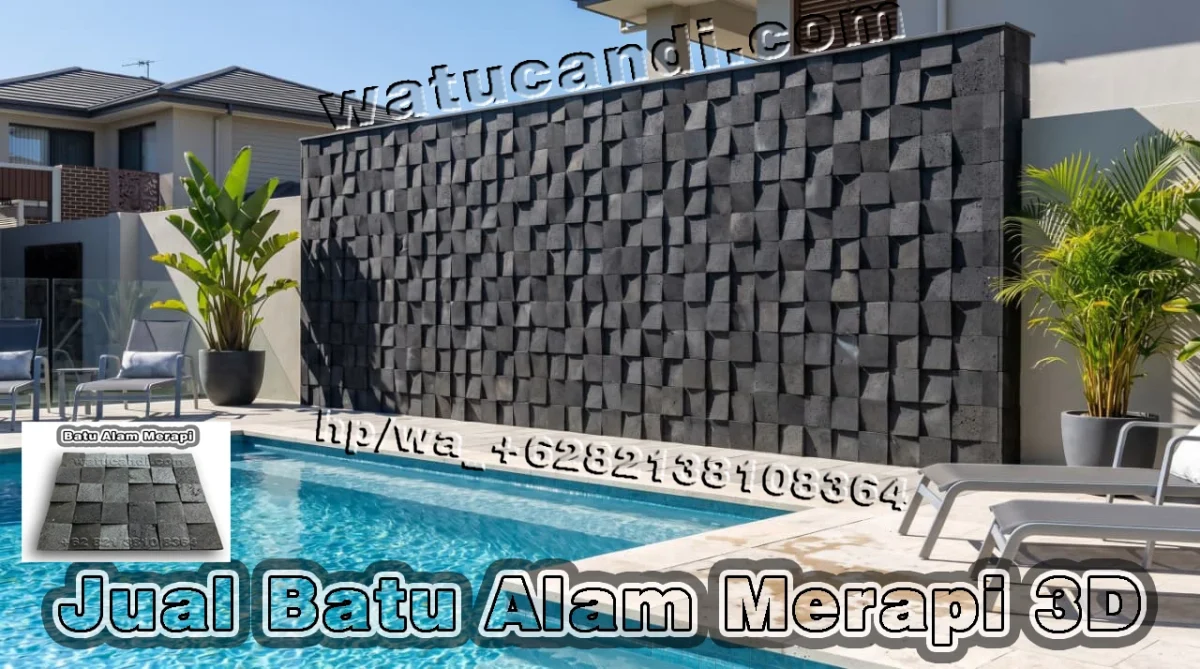
Garden Walls and Landscape: Integration of natural stone in garden landscaping is a very popular application. Black stone can be used to coat retaining walls, swimming pool walls, or fountain features.
Integration with Design Styles
Modern Tropical Style: Modern tropical style emphasizes the use of natural materials, cross ventilation, and indoor-outdoor blending. Lava stone is a key material in this style. See our commercial design and modern luxury home design inspiration.
Industrial and Minimalist Style: In industrial design, raw and exposed materials are highly valued. Black stone with its natural volcanic texture fits perfectly with this style. Learn more about industrial design and interior design.
Classical and Traditional Javanese Style: For those who want to maintain traditional Javanese nuances, temple stone is an irreplaceable choice. The use of this natural stone on pendopo walls, gates, or Javanese-style living rooms creates a direct connection with the architectural heritage of the archipelago.
Zen and Wabi-Sabi Style: The Zen and Wabi-Sabi philosophy from Japan appreciates imperfection, simplicity, and unmade natural beauty. Pedra hitam from Merapi, with its color variations, pores, and asymmetric thickness (1 cm and 2 cm), is a perfect manifestation of Wabi-Sabi.
8. Various Benefits and Practical Applications of 3D Stone Wall Slabs
Beyond wall cladding, these Natural Stone Products offer a variety of additional functions:
- Focal Point Creator – Transforms one wall area into the center of attention in a room.
- Natural Echo Dampener – The uneven surface breaks up sound waves, therefore suitable for home theaters or music rooms.
- Wall Camouflage – In addition, the Three-Dimensional Texture of Natural Stone can hide imperfections of the original wall.
- Branding Element – Gives a strong character to cafes, restaurants, boutiques, or hotel lobbies. See our restaurant design and hotel design.
- Decorative Accent – Ideal for columns, pillars, kitchen backsplashes, or fireplace frames.
9. Placement Recommendations for Merapi 3D Stone Slabs in Various Spaces
The high durability of Mount Merapi stone makes this material flexible for many locations:
- Living Room & Family Room – The wall behind the TV or sofa instantly looks luxurious. See comfort decoration design.
- Hotel Lobby, Office, Reception – A masculine and classy impression radiates from the very first step. See corporate design.
- Bathroom & Spa – As long as we apply a sealer regularly, the surface remains safe from high humidity.
- Kitchen – A heat-resistant backsplash that is easy to clean.
- Semi-Outdoor Terrace & Vertical Garden – Blends naturally with plants and sunlight. Learn about proper lighting design.
- Industrial Restaurant & Bar – Paired with Edison pendant lights, a warm atmosphere is immediately created.
- Fireplace – The reflection of flames dances over the shadow texture, thus adding romance to the space.
10. Complete Installation Guide for Natural Stone
Wall Surface Preparation
Before installing natural stone, the wall surface must be properly prepared. The wall must be clean from dust, oil, peeling paint, or other loose materials. If the wall is made of red brick or concrete blocks, ensure the plaster has dried perfectly (minimum 21 days).
Selection of Adhesive Material
The choice of adhesive is very crucial for temple stone. Because lava stone has high density, the use of conventional cement (sand and cement mixture) is often not strong enough. It is recommended to use high-quality tile adhesive that is flexible and has high adhesion (type C2 or equivalent).
10×10 cm Pattern Installation Techniques
Running Bond Pattern: This is the most common and safe pattern. Black stone pieces are arranged with a 50% offset (the middle of the top piece is above the joint of the bottom piece).
Straight Grid Pattern (Stack Bond): In this pattern, all vertical and horizontal joints are aligned straight, forming a perfect grid. This pattern gives a very modern, minimalist, and firm impression.
Random and Artistic Pattern: Given that the thickness of this natural stone varies (1 cm and 2 cm), the installer can rotate or flip the pieces randomly to create a very dynamic and organic surface. See other unique models and latest styles.
Handling 1 cm and 2 cm Thickness
When installing lava stone with dual thickness, there are two main approaches:
- Random Flipping: The installer flips the pieces randomly (1 cm side facing out, then 2 cm side facing out). This creates a wavy wall surface (3D texture).
- Directed Flipping: The installer installs all pieces with the same side facing out, or creates a specific pattern (for example, first row 1 cm side, second row 2 cm side).
Grouting and Joint Finishing
After the black stone is installed and the adhesive dries (usually 24-48 hours), the next step is grouting (joint filling). For lava stone, it is recommended to use dark-colored grout (black or dark gray) so it blends with the stone and does not dominate the visual.
11. Long-term Care and Maintenance
Routine and Daily Cleaning
Natural stone from Merapi is basically a low-maintenance material. For routine cleaning, just use a damp cloth or soft broom to remove dust. If there are light stains, wipe with water and mild dish soap.
Deep Cleaning
For temple stone in exterior areas exposed to moss or mold, use a mixture of water and bleach (baking soda or white vinegar is more recommended for environmental friendliness). Spray on the problem area, let sit for 10-15 minutes, then scrub with a nylon brush and rinse with low-pressure water.
Coating Application and Anti-Mold Coating
Although black stone is naturally weather-resistant, application of sealer or coating for natural stone is highly recommended, especially for exterior applications or wet areas (bathrooms, swimming pools). Use water or solvent-based impregnating sealer that does not change the natural color of lava stone (matte finish). Learn more about maintenance support.
Overcoming Common Problems (Moss, Stains, Cracks)
- Moss/Mold: Treat with special natural stone cleaner or vinegar solution. Ensure the area gets sufficient air circulation and sunlight.
- Oil/Ink Stains: Immediately absorb with a cloth. For stubborn stains, use a paste of baking soda and water, apply to the stain, and let sit overnight before scrubbing.
- Cracks in Stone: If there is a cracked piece of natural stone, the only solution is to dismantle the piece and replace it with a new one.
12. Economic Aspects and Property Investment Value
Natural Stone Installation Cost Analysis
The investment to use lava stone includes material costs, adhesive/grout costs, and installation labor costs. Although the initial cost of temple stone may be higher compared to wall paint or wallpaper, its lifespan of almost a lifetime makes it very economical in the long run. See our fair prices.
Impact of Black Stone on Property Sales Value
The use of premium materials like Merapi natural stone significantly increases the aesthetic value and quality perception of a property. Potential buyers or tenants often associate black stone walls with luxury, sturdiness, and high design taste.
Comparison with Other Wall Materials
- Vs. Exposed Brick: Exposed brick provides an industrial nuance, but lava stone offers richer texture, more elegant color (dark gray/black), and better weather resistance.
- Vs. Wood: Wood provides warmth, but is vulnerable to termites, decay, and requires intensive maintenance. Temple stone is termite-free, fire-resistant, and much easier to maintain.
- Vs. Ceramic/Porcelain: Ceramics mimic stone, but often look “fake” and repetitive. Original pedra hitam offers uniqueness in every piece that cannot be replicated by ceramic printing machines.
13. Sustainability, Environment, and Social Impact
Sustainable Mining on Merapi Slopes
The natural stone industry around Merapi has shifted towards more sustainable practices. Lava stone mining now utilizes more material carried by cold lava flows (river deposits) or takes from designated areas without damaging the mountain structure. Learn about our quality materials and guaranteed work.
Economic Impact for Local Communities
The cutting and processing industry of black stone into 10×10 cm sizes absorbs a large number of local labor. Starting from miners, transporters, cutting machine operators, to polishers. Income from this temple stone industry becomes the economic backbone for many villages on the slopes of Merapi (such as in the Sleman and Magelang areas).
Carbon Footprint and Environmental Friendliness
Compared to artificial materials like steel, aluminum, or concrete that require high-temperature burning processes and produce large carbon emissions, natural stone has a very low carbon footprint. The process only requires mechanical cutting and transportation. In addition, lava stone is a 100% natural material and can be recycled or returned to nature without polluting the environment at the end of its lifespan.
14. Conclusion and Final Recommendations
Summary of Product Advantages
Natural stone from Mount Merapi formed into 10×10 cm sizes with asymmetric thickness of 1 cm and 2 cm is an extraordinary wall cladding material. It combines the geological strength of lava stone, the historical aesthetics of temple stone, and the elegance of black stone (or pedra hitam) in one versatile product. The uniqueness of its dual thickness offers a 3D artistic dimension that cannot be mimicked by other materials.
Recommendations for Architects, Designers, and Homeowners
For professionals and homeowners, we highly recommend using this lava stone for projects that prioritize sustainability, uniqueness, and long-term value. Make sure to:
- Choose a supplier that provides natural stone with grade A quality. Learn why you should choose us.
- Use experienced installers in natural stone installation, especially in handling thickness variations. See our experience and expertise.
- Apply the right sealer according to the installation location (interior/exterior). Learn more about our product information.
Closing: Volcanic Power in an Elegant Touch
Mount Merapi has provided more than just fertile soil; it provides material capable of building beauty. Every 10×10 cm piece of temple stone you install on the wall is a fragment of Nusantara’s geological history, a natural work of art that has forged itself through fire and time. By choosing this lava stone, you not only beautify the building, but also embrace the power of nature and Indonesian cultural heritage in your home.
Transform ordinary walls into eternal masterpieces with black stone from Mount Merapi. Let nature speak through the texture, color, and dimensions it creates, and watch how your space changes into a place full of character, tranquility, and timeless elegance.
Ultimately, the authenticity of volcanic material and unique dimensions from the precision machining process make these stone slabs not just wall cladding, but an artistic canvas that continues to speak through light.
Tags: natural stone, indonesian natural stone, merapi natural stone, temple stone, lava stone, lava stone, black stone, pedra hitam, wall cladding, interior design, modern architecture, natural stone manufacturer, jogja natural stone, magelang natural stone, 3D Merapi Mountain Stone, 3D natural stone, latest natural stone, old natural stone, handmade natural stone, classic natural stone, unique natural stone, 100x100mm natural stone, wall natural stone, modern natural stone, bali natural stone, jakarta natural stone, natural stone export, natural stone quality, muntilan natural stone, sleman natural stone,


One thought on “Introducing Merapi 3D Stone Slabs: An Artistic Wall with Uneven Thickness”