'%3E%3Cpath%20stroke='%23000'%20stroke-width='4'%20d='m-35-37-13%2020m5%203%2013-20m5%203-13%2020m63%2042%206-9m1-2%206-9m5%203-6%209m-1%202-6%209m5%203%206-9m1-2%206-9m-96%200%2013%2020m5-3-6-9m-1-2-6-9m5-3%2013%2020m63-42-6-9m-1-2-6-9m5-3%2013%2020m5-3-6-9m-1-2-6-9'/%3E%3Ccircle%20r='24'%20fill='%23cd2e3a'/%3E%3Cpath%20fill='%230047a0'%20d='M0%200a12%2012%200%201%201%2020%2013%2024%2024%200%201%201-40-26A12%2012%200%201%200%200%200'/%3E%3C/g%3E%3C/svg%3E)


'/%3E%3Cpath%20fill='%23b2b2b2'%20d='M241%20382q0%2016%2017%2026%2017%2011%2042%2011t42-11q16-11%2017-26V269H241'/%3E%3Cpath%20fill='%239f7e00'%20d='M241%20379q0%2014%208%2023%209%209%2021%209%2014%200%2021-9%209-9%209-23V269h-59'/%3E%3Cpath%20d='M241%20339v-70h59v110q0%2014-9%2023l-6%205v-68h-15v72q-8%200-14-4v-68zm59%2040c0%2022%2015%2032%2029%2032%2021%200%2030-18%2030-32v-40h-59'/%3E%3Cpath%20fill='%239f7e00'%20d='M266%20277v5h2v12h-3v-5h2v-5h-9v5h2v5h-4v9h3v18h-5v10h34v-10h-5v-18h3v-9h-4v-5h2v-5h-9v5h2v5h-3v-12h2v-5zm42%20101q0%2010%206%2017%206%206%2015%207%2010-1%2016-7%206-7%206-17v-29h-43'/%3E%3Ccircle%20fill='%230044ad'%20cx='329.5'%20cy='372'%20r='6'/%3E%3Cellipse%20fill='%230044ad'%20cx='300'%20cy='340'%20rx='16'%20ry='21'/%3E%3C/svg%3E)



Palimanan Paras Stone Tiles are a flooring and wall material from high‑quality volcanic sedimentary rock quarried in Palimanan Village, West Java. Architects, contractors, and homeowners prize them for their unique characteristics: a blend of natural stone strength, beautiful cream to grey colours, and surface textures that create a warm and elegant ambience in any room. This article thoroughly explores everything about Palimanan Paras Stone Tiles, from geological origins, mining and production processes, technical specifications, advantages and disadvantages, installation guides, maintenance, to design inspiration and comparisons with other materials.
The popularity of Palimanan Paras Stone Tiles continues to rise along with interior and exterior design trends that re‑embrace natural elements. This material offers a solution for those who want an organic yet luxurious look without sacrificing functional aspects such as weather resistance and ease of maintenance. It is no wonder that five‑star hotels, resorts, villas, upscale restaurants, and private residences often choose this material as both a main element and a decorative accent.
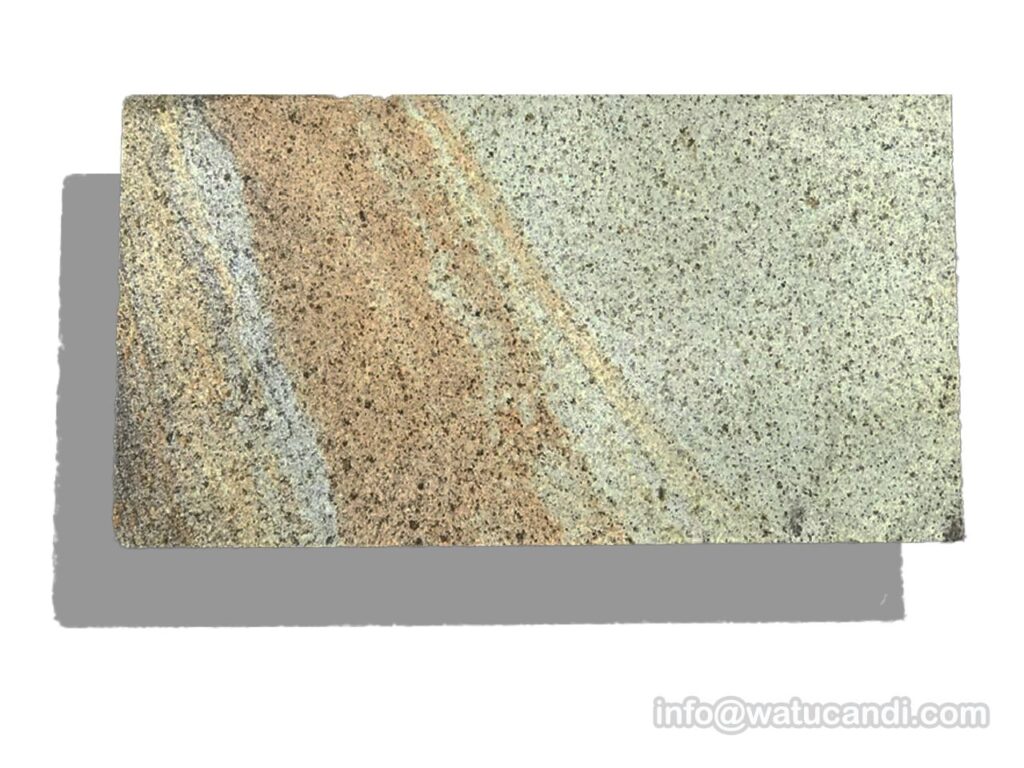
Table of Contents
- Definition of Palimanan Paras Stone Tiles
- Geological Origin and Mining History
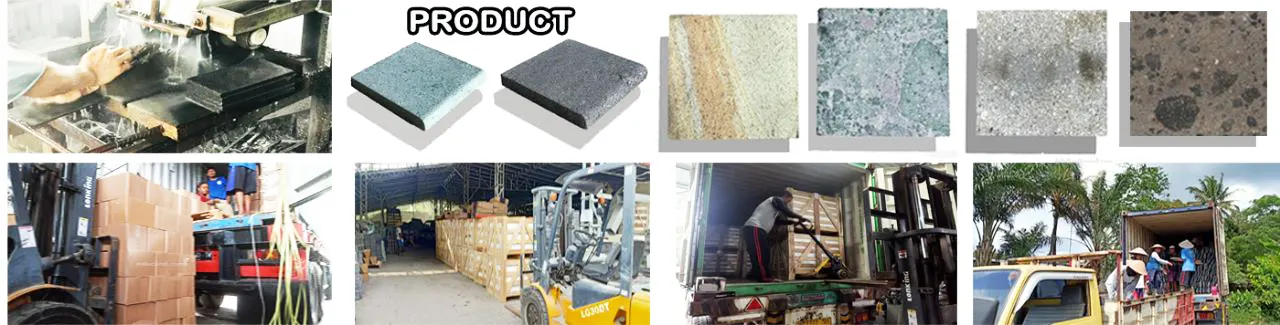
- Mining and Production Process
- Physical and Chemical Characteristics
- Advantages of Palimanan Paras Stone Tiles
- Disadvantages and How to Overcome Them
- Types and Variations Based on Finishing
- Applications in Buildings
- Installation Guide
- Maintenance of Palimanan Paras Stone Tiles
- Price Range in the Market
- Comparison with Other Materials
- Tips for Choosing Quality Palimanan Paras Stone Tiles
- Interior and Exterior Design Inspiration
- Conclusion
Definition of Palimanan Paras Stone Tiles
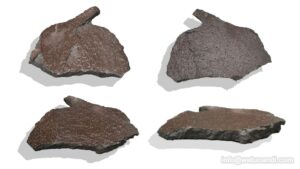
Palimanan Paras Stone Tiles are a processed product of a volcanic sedimentary rock known as Palimanan Paras Stone. The term “paras” in the local language refers to rock formed from volcanic material such as ash and dust that underwent natural compaction and cementation over thousands to millions of years. This rock falls into the tuff or pyroclastic category and has a special characteristic: it is relatively light compared to granite or marble, yet strong enough to withstand loads.
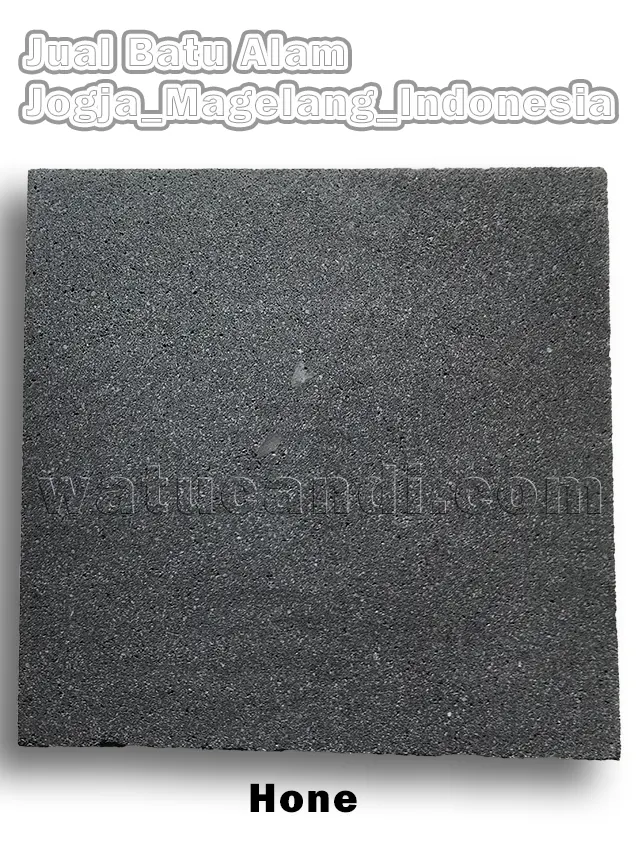
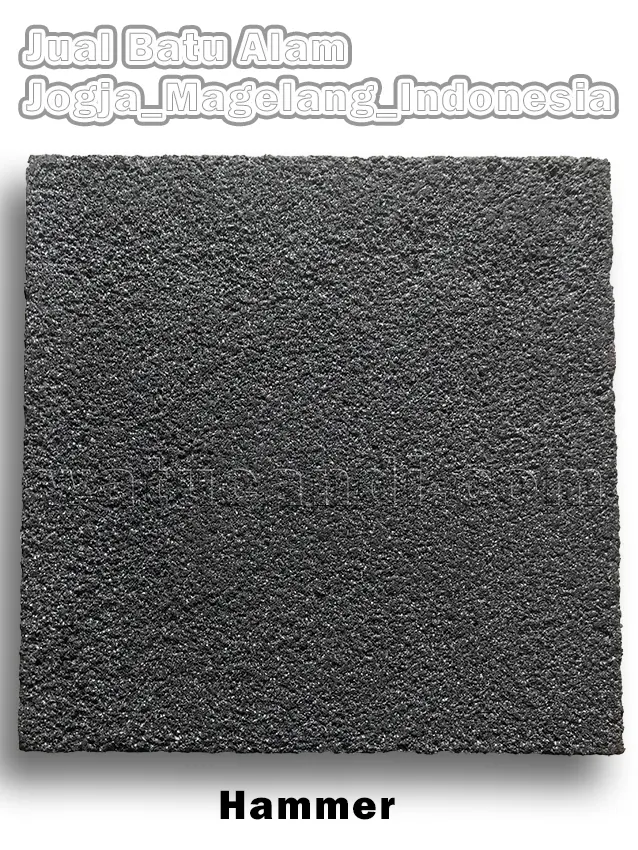
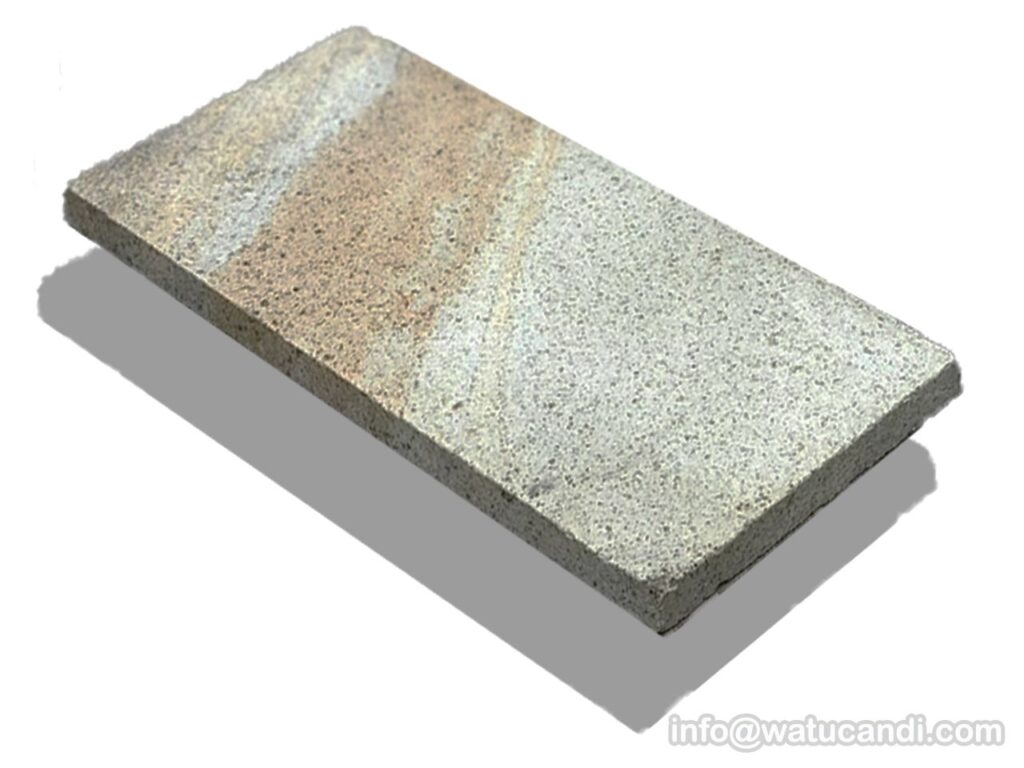
In tile form, Palimanan Paras Stone is cut to precise dimensions, typically in square or rectangular formats with thicknesses varying from 1 cm to 3 cm, depending on the application. The surface can be finished using various techniques such as honed (smoothly sanded), brushed (wire‑brushed for a soft texture), bush‑hammered (struck for an anti‑slip effect), or natural cleft (naturally split). Each finishing type offers different visual and functional characteristics, making the tiles flexible for interior floors, accent walls, terraces, carports, and even busy commercial areas.
The main excellence of Palimanan Paras Stone Tiles lies in their aesthetics. Their colours, dominated by light cream, golden cream, light grey, and dark grey with subtle brown touches, together with unique natural patterns that never repeat, give a warm and luxurious feel that is hard to imitate with artificial materials. Each tile is a unique natural work of art, making any room that uses it feel special and personal.
Geological Origin and Mining History
Palimanan Paras Stone has a long and fascinating geological history. This rock was formed from volcanic material ejected by ancient volcanoes in the West Java region millions of years ago. Volcanic ash, dust, and other pyroclastic materials that were thrown into the air then settled on land and on water bodies. Subsequently, these materials underwent compaction (densification) and cementation (bonding) by minerals such as silica, calcite, and clay. This process took place on a very long geological time scale, producing rock that is fairly hard yet can still be cut and shaped with the right tools.
The name “Palimanan” itself is taken from Palimanan Village in Cirebon Regency, West Java, which is the centre of stone mining and processing. The Palimanan area and its surroundings are indeed known to have abundant deposits of high‑quality paras stone. For decades, the local community has relied on the mining and craftsmanship of paras stone as their main livelihood. The hereditary skills in mining, cutting, and processing paras stone have given Palimanan products an excellent reputation in both national and international markets.
Geologically, Palimanan Paras Stone belongs to the Quaternary volcanic rock formation spread along the volcanic belt of Java. Its composition is dominated by silica minerals, feldspar, and other volcanic rock fragments bound in a fine matrix. It is this mineral content that gives the characteristic cream colour highly sought after by designers and architects. Interestingly, not all paras stone has the same quality; only certain deposits produce stone with sufficient density, consistent colour, and texture ideal for making tiles.
Mining and Production Process of Palimanan Paras Stone Tiles
Mining Paras Stone
Miners carry out the mining of Palimanan Paras Stone using open‑pit methods that are relatively simple yet require special skills. They dig through the overburden layer to reach the high‑quality paras stone layer. Unlike granite or marble mining which uses large heavy equipment, paras stone mining relies more on manual skills and semi‑mechanical tools to keep the stone from cracking or breaking uncontrollably.
Cutting and Shaping
After large paras stone blocks are successfully lifted from the quarry, the next stage is cutting. The blocks are cut into smaller blocks using special stone saws (gang saw or diamond wire saw). These smaller blocks are then sliced into thin slabs according to the desired thickness. This process requires high precision to ensure every tile has uniform thickness, making installation easier and producing a flat surface.
Paras Tile Finishing Techniques
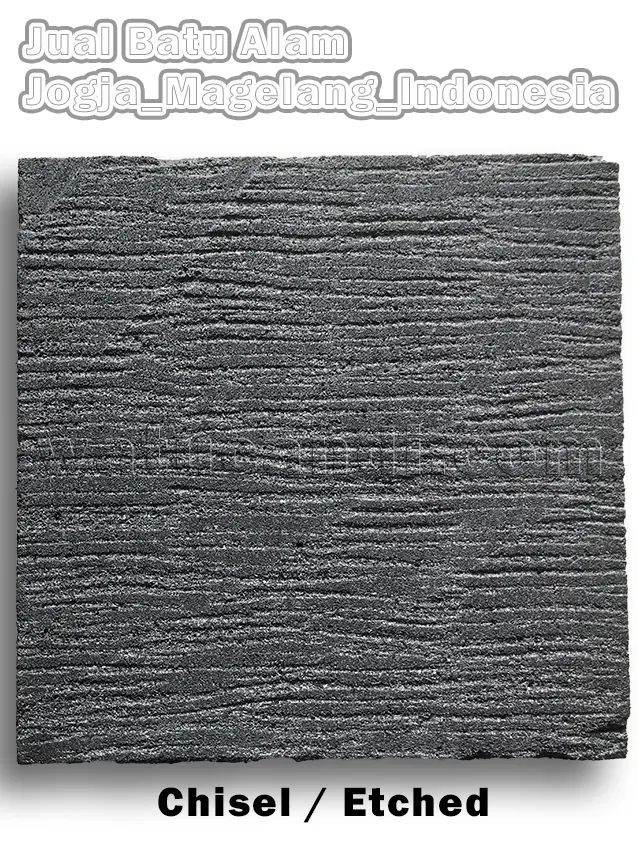
The finishing stage is a crucial step that determines the final appearance of the tile. Unlike hard volcanic stones such as andesite or basalt which can be finished with a flamed technique until the surface spalls, paras stone has a different character. Paras stone will not spall when burned; instead, it risks cracking or scorching. Therefore, finishing techniques for paras stone rely more on mechanical methods. Several finishing techniques are commonly applied to Palimanan Paras Stone Tiles:
- Honed: The stone surface is sanded with a special sanding machine until smooth and flat. The result is a soft surface with a natural lustre that does not shine like marble, ideal for modern minimalist interiors.
- Brushed: The stone surface is brushed with a wire brush or special abrasive brush to remove the softer surface layer and highlight the stone’s natural texture. The result is a slightly textured surface that remains comfortable underfoot yet provides better grip than honed. This finish is very popular for family room floors, corridors, and indoor‑outdoor transition areas. Its warm and natural appearance suits various design styles.
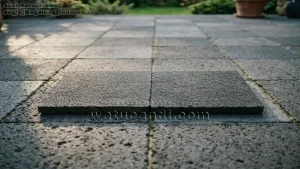
- Bush Hammered: The stone surface is hammered with a special tool that has many small chisel heads to create a fine wavy texture. The result is an anti‑slip surface with an artistic rustic look. It is suitable for wet areas such as bathrooms, pool surrounds, outdoor terraces, and walkways. Its distinctive texture is also often used as a decorative element on accent walls and pillars.
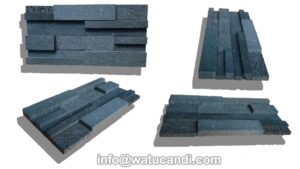
- Natural Cleft: The stone is split following its natural bedding direction, producing a naturally rough and uneven surface. Because of its highly textured nature, this finish is best suited for interior and exterior accent walls, fences, pillars, and other decorative elements. It is not recommended for floors because the overly rough surface may reduce comfort.
- Tumbled: The tiles are placed in a rotating machine together with small stones and water to erode sharp edges and create an aged, antique, and time‑worn look. Tumbled tiles have a very distinctive rustic appearance, ideal for Mediterranean, farmhouse, or vintage design styles. The surface feels soft underfoot with a slight natural texture.
Each finishing technique requires different skills and equipment. The craftsmen in Palimanan have mastered these techniques over generations, producing tiles of a quality that can compete in the global market. The final product is then sorted by colour quality, size, and thickness before being packaged and distributed to various regions in Indonesia or exported abroad.
Physical and Chemical Characteristics of Palimanan Paras Stone Tiles
To understand why Palimanan Paras Stone Tiles are so special, we need to delve deeper into their physical and chemical characteristics. This knowledge will also help in determining the right maintenance and the most suitable applications.
Natural Stone Colour
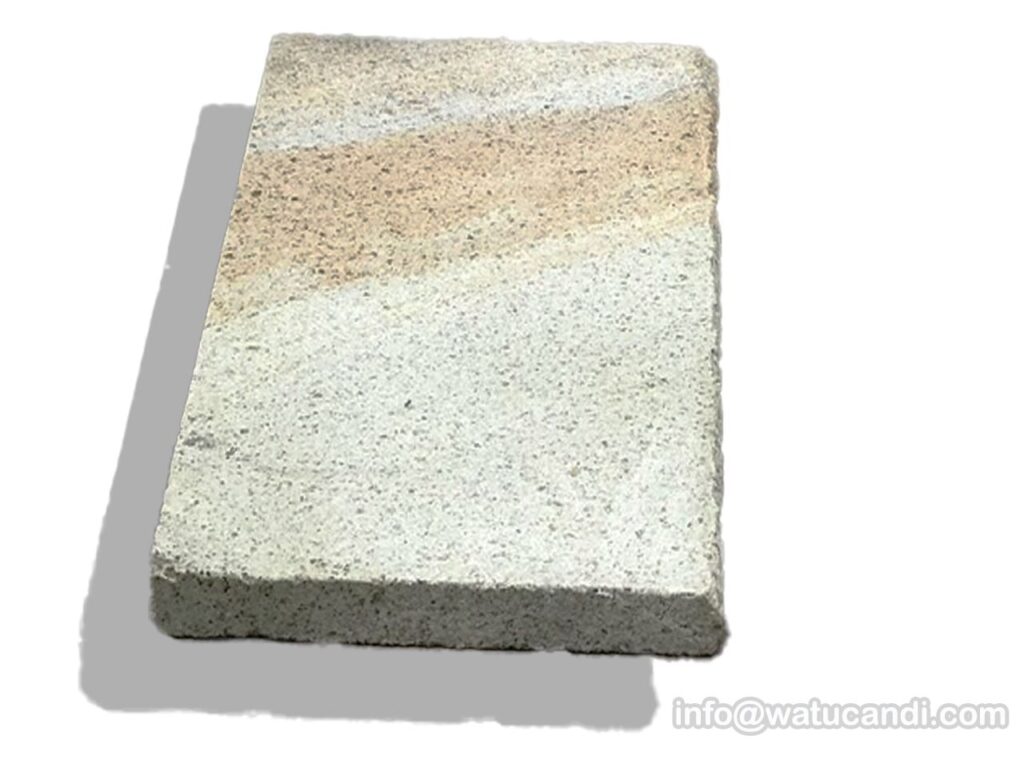
The colour of Palimanan Paras Stone Tiles is one of their main attractions. Their colour spectrum ranges from white cream, golden cream, light grey, medium grey, to dark grey with subtle brown touches. This colour variation occurs because of differences in mineral composition and the degree of oxidation that took place during the rock formation process. Younger stone tends to be lighter in colour, while older stone or stone containing more iron minerals will be darker.
Interestingly, unlike paint or synthetic materials whose colours are uniform and “flat”, the colour of Palimanan Paras Stone Tiles has living depth and dimension. Under different lighting natural sunlight, warm yellow lamps, or white lamps this stone can show slightly different colour nuances, creating an interesting visual dynamic throughout the day.
Stone Pattern
The patterns on Palimanan Paras Stone Tiles are formed from the uneven mixture of minerals during the geological process. These patterns generally consist of a blend between lighter and darker areas that form abstract motifs such as clouds, waves, or subtle gradations. Some types of Palimanan Paras Stone have fairly consistent and repetitive patterns, while other types display very random and dramatic patterns.
It is these natural patterns that make each tile unique and impossible to duplicate. For designers, this uniqueness actually becomes an added value because it creates a truly exclusive floor or wall installation. No two rooms will look exactly the same even if they use the same type of stone from the same quarry.
Stone Surface Texture
Naturally, Palimanan Paras Stone has a hard and dense texture, with fine grains visible on its surface. The density level of this stone varies depending on the mining location and the depth of the deposit. Stone taken from deeper layers usually has higher density and lower porosity, making it more resistant to water and stains.
The surface of Palimanan Paras Stone Tiles that has been finished with the honed technique tends to be smooth with a few natural pores that give a luxurious and elegant impression. Meanwhile, brushed or bush‑hammered finishes produce a texture that is more noticeable underfoot with good anti‑slip properties, making them a functional choice for areas that require extra safety. The choice of finish should be tailored to the installation location and aesthetic preferences.
Physical and Chemical Properties
From a technical standpoint, Palimanan Paras Stone has several important properties you should know:
- Specific Gravity: Ranges between 2.2 – 2.6 g/cm³, lighter than granite (2.6‑2.8 g/cm³) yet heavy enough to give a solid impression.
- Hardness: At a level of 3‑4 on the Mohs scale, softer than granite (6‑7) or marble (3‑5). This means paras stone can be cut and shaped relatively easily, but is also more susceptible to scratches from sharp objects.
- Porosity: Fairly high, especially for natural cleft finishing. Sealer coating is necessary to protect against stains and moisture, particularly for floor and wet area applications.
- Water Absorption: Varies between 2‑8%, depending on density and finishing. The lower the absorption, the better its resistance to weather and stains.
- Chemical Composition: Dominated by silica (SiO₂), alumina (Al₂O₃), calcium oxide (CaO), and iron oxide (Fe₂O₃), which give the colour variation.
Understanding these properties is important to determine the right application, installation method, and type of maintenance needed so that Palimanan Paras Stone Tiles remain beautiful and durable for many years.
Advantages of Palimanan Paras Stone Tiles
Why do Palimanan Paras Stone Tiles become the choice for many prestigious projects? Here are the advantages that make this material superior:
- Natural and Luxurious Aesthetics: No artificial material can replicate the natural beauty of Palimanan Paras Stone Tiles. Their unique patterns and colours create a warm, elegant, and organic atmosphere. They suit traditional, classic, modern minimalist, and even industrial architectural styles.
- Long-lasting: Although not as hard as granite, Palimanan Paras Stone Tiles have excellent resistance to loads and light impacts. With correct installation and maintenance, floors made from this stone can last for decades without significant quality degradation.
- Environmentally Friendly: As a natural product, their production process does not involve hazardous chemicals and requires relatively less energy compared to ceramic or porcelain production. At the end of their service life, the stone can return to nature without polluting the environment.
- Property Investment Value: Using Palimanan Paras Stone Tiles on floors or walls can significantly increase the selling price and rental value of a property. Premium natural materials are always a special attraction for prospective buyers or tenants who appreciate quality and aesthetics.
- Natural Thermal Insulation: Natural stone has the ability to store and release heat slowly. Floors made from Palimanan Paras Stone Tiles feel cool during the day and warm at night, creating natural thermal comfort without the need for artificial cooling or heating.
- Available in Various Finishes: With choices of honed, brushed, bush hammered, natural cleft, and tumbled, Palimanan Paras Stone Tiles can be adapted to any function and design style.
These advantages make Palimanan Paras Stone Tiles a material of choice that is not only visually beautiful but also economically and ecologically wise.
Disadvantages and How to Overcome Them
No material is perfect. Palimanan Paras Stone Tiles also have several disadvantages that need to be understood so that they can be anticipated and their impact minimised:
- Fairly High Porosity: This stone has natural pores that can absorb liquids if not sealed. Solution: always apply a high‑quality sealer before and after installation, and re‑seal periodically every 1‑2 years.
- Prone to Scratches from Sharp Objects: With a hardness of 3‑4 on the Mohs scale, the surface of paras stone can be scratched by sharp metal objects or coarse sand. Solution: wear soft indoor footwear, place doormats at entrances to trap abrasive sand and dirt, and avoid dragging heavy furniture directly across the floor.
- Colour Change Over Time: Some types of paras stone, especially lighter colours, may undergo slight colour changes due to oxidation or UV exposure. Solution: choose the best quality stone, apply a sealer with UV protection, and accept this natural change as part of the patina that adds character.
- Requires Special Installation Skills: Natural stone tile installation cannot be equated with ordinary ceramic tiles. Experienced stone masons are required. Solution: always use professional installation services with a natural stone portfolio.
By understanding these disadvantages and applying the right solutions, you can enjoy the beauty of Palimanan Paras Stone Tiles without significant problems in the long term.
Types and Variations Based on Finishing
Palimanan Paras Stone Tiles come in several finishing variations, each with different visual and functional characteristics. Understanding these differences is crucial for choosing the right type according to the installation location and desired design style.
1. Honed Finish
Honed finishing produces a smooth, flat, and matte (non‑shiny) surface. Tiles with this finish are perfect for interior floors such as living rooms, bedrooms, and upscale commercial areas. The softness of the surface creates comfort when stepped on barefoot. Visually, honed finishing highlights the beauty of the stone’s natural colour and pattern without excessive light reflection.
2. Brushed Finish
Brushed finishing is produced by brushing the stone surface with a wire brush or special abrasive brush. This process removes the softer surface layer and highlights the stone’s natural texture. The result is a surface with a light texture that remains comfortable underfoot yet has better grip than honed. This finish is very popular for family room floors, corridors, and indoor‑outdoor transition areas. Its warm and natural appearance makes it suitable for various design styles.
3. Bush Hammered Finish
Bush hammered finishing is made by hammering the stone surface with a special tool that has many small chisel heads. The result is a surface with a regular yet natural wavy texture. The anti‑slip level of this finish is quite good and its appearance is very artistic. It is suitable for wet areas such as bathrooms, pool surrounds, outdoor terraces, and walkways. Its distinctive texture is also often used as a decorative element on accent walls and pillars.
4. Natural Cleft Finish
Natural cleft finishing retains the stone’s original surface as it is split naturally. The surface is rough and uneven, with natural bumps and depressions that give a very organic character. Because of its highly textured nature, this finish is best suited for interior and exterior accent walls, fences, pillars, and other decorative elements. It is not recommended for floors because the overly rough surface may reduce comfort.
5. Tumbled Finish
Tumbled finishing is created by placing the tiles in a rotating machine together with small stones and water to erode sharp edges and create an aged, antique, and time‑worn look. Tumbled tiles have a very distinctive rustic appearance, ideal for Mediterranean, farmhouse, or vintage design styles. The surface feels soft underfoot with a slight natural texture.
It is important to note that the finishing on paras stone differs from that on hard volcanic stones such as andesite or basalt. Paras stone does not spall when burned, so the flamed technique is not applied to this type of stone. Every finishing technique mentioned above has been tested and is suitable for the characteristics of paras stone.
Applications of Palimanan Paras Stone Tiles in Buildings
Palimanan Paras Stone Tiles have high flexibility in their application. Here are the main functions of this material in the world of construction and design:
For Floors
Palimanan Paras Stone Tiles are often used as natural stone flooring in various rooms of buildings. With a honed or brushed finish, paras stone floors provide an elegant and long‑lasting appearance, making them suitable for high‑traffic areas such as living rooms, hotel corridors, lobbies, and commercial areas. For areas that require extra safety such as bathrooms or outdoor terraces, a bush hammered finish is the right choice due to its anti‑slip properties.
For Walls
In addition to flooring, Palimanan Paras Stone Tiles are also very popular as a wall material. This stone gives a classic and aesthetic look to walls, so it is often used in classically styled, traditional, tropical modern, and even industrial buildings. As a floor or wall material, paras stone can create a captivating focal point in any room. An accent wall of natural cleft or bush hammered paras stone in the living room or master bedroom can be a very classy decorative element.
As Outdoor Decoration
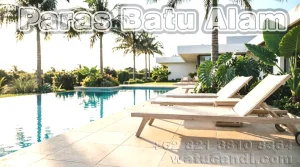
Palimanan Paras Stone Tiles are also often used as decoration in outdoor areas such as gardens, yards, walkways, and outdoor seating areas. This stone gives a natural and beautiful appearance, making it suitable for creating harmony between the building and its surrounding environment. For outdoor applications, it is advisable to choose more textured finishes such as bush hammered or brushed to remain safe when wet.
Craft and Architectural Elements
Besides being used as floor and wall tiles, Palimanan Paras Stone is also often utilised for various architectural elements and natural stone crafts. This material can be shaped into pillars, columns, cornices, wall ornaments, reliefs, and even garden furniture such as benches and tables. Its relatively soft nature compared to granite makes it easy to carve and shape, so it is widely used by natural stone craftsmen to create detailed and artistic decorative works.
Installation Guide for Palimanan Paras Stone Tiles
Installing Palimanan Paras Stone Tiles requires special techniques that differ from ordinary ceramic tile installation. Here are the general steps you should pay attention to:
1. Preparation of the Base Surface
You must ensure the base surface (floor or wall) is flat, clean, and free from dust, oil, or other loose materials. For floors, the screed or plaster must be completely dry and have the correct slope for drainage. An uneven surface will cause the tiles to easily crack or come loose later on.
2. Soaking the Tiles (Optional)
Some types of paras stone should be briefly soaked in water before installation, especially if using the wet installation method with cement. The soaking aims to prevent the stone from absorbing too much water from the cement mixture, which could cause cracking or discolouration. However, for modern installation methods with special adhesives, this step may not be necessary. Consult your stone supplier or professional tile setter.
3. Choosing the Adhesive
Use a special natural stone adhesive (thin‑bed mortar) that has high bond strength and good flexibility. Avoid using ordinary cement as it can cause discolouration of the stone (efflorescence) and less optimal adhesion. For wet areas, choose an adhesive with water resistance.
4. Installation and Arrangement
Install the tiles leaving a gap (joint) of about 2‑5 mm to accommodate expansion. Use spacers to maintain consistent spacing between tiles. Before the adhesive dries, check the surface flatness using a spirit level. Immediately clean any adhesive residue stuck to the tile surface before it hardens.
5. Grouting
After the adhesive is completely dry (24‑48 hours), fill the gaps between tiles with suitable grout. Choose a matching grout colour for a unified look, or a contrasting colour to highlight the installation pattern. Clean excess grout from the tile surface before it dries using a damp sponge.
6. Sealer Application
After the grout is completely dry, apply a special natural stone sealer to the entire tile surface. The sealer will protect the stone from stains, water, and dirt. For best results, apply the sealer evenly and allow it to soak in according to the product instructions.
Maintenance of Palimanan Paras Stone Tiles
Palimanan Paras Stone requires regular maintenance to stay durable and long‑lasting. Here are the recommended care guidelines:
Clean Regularly
Clean Palimanan Paras Stone Tiles regularly with a soft broom, vacuum cleaner, or microfibre mop to remove dust and dirt. Do not use abrasive brushes or cleaning agents that contain harsh chemicals such as acids, alkalis, or bleach, as they can damage the stone surface.
Use Water and Mild Soap
For stubborn stains or dirt, use warm water mixed with pH‑neutral soap (special natural stone soap). Wipe with a soft cloth or sponge, then rinse with clean water. Do not let water puddle on the stone surface; dry immediately with a clean cloth.
Avoid Excessive Water Exposure
You need to avoid excessively spraying water on the surface of Palimanan Paras Stone Tiles, especially on floor areas that are frequently exposed to water. Excessive and prolonged water exposure can accelerate rock weathering, trigger moss growth, and damage the surface.
Re‑seal Periodically
To protect the surface of Palimanan Paras Stone Tiles from water and stains, carry out sealing with a special natural stone sealer product. The sealer works by filling the stone pores without changing its natural colour. Re‑seal every 1‑2 years, or more frequently for high‑traffic and frequently wet areas. Before re‑sealing, ensure the stone surface is clean and completely dry.
Avoid Physical Damage
You must avoid impacts or scratches that can damage the surface of Palimanan Paras Stone Tiles. Do not use sharp or rough objects on the stone surface. Avoid stepping on the stone with sharp high heels or heavy boots. Use protective pads under furniture feet and avoid dragging heavy items directly across the floor. If damage such as cracks or breaks occurs, immediately replace the damaged tiles to prevent further damage.
With proper care, Palimanan Paras Stone Tiles will continue to look beautiful and last for a very long time.
Price Range of Palimanan Paras Stone Tiles in the Market
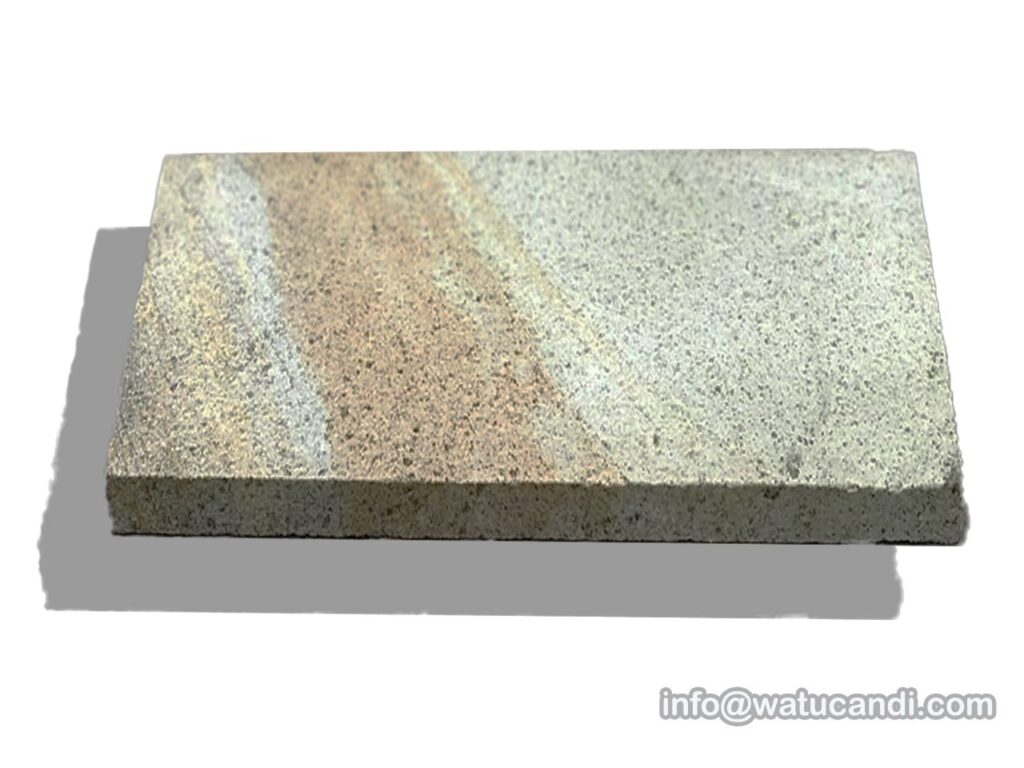
The price of Palimanan Paras Stone Tiles varies depending on several factors: size, thickness, type of finish, colour quality, and purchase location. Generally, the price of paras stone tiles ranges from Rp150,000 to Rp450,000 per square metre. Honed finishing is usually in the mid‑price range, while special finishes such as brushed, bush hammered, or tumbled may be slightly more expensive because they require additional processes.
For large projects, buying directly from suppliers or craftsmen in Palimanan can provide more competitive prices. Also visit our product page at natural stone to view the latest catalogue and prices for Palimanan Paras Stone Tiles and other natural stone materials. Make sure to compare prices from several sources and always request a physical sample before buying in large quantities.
Comparison of Palimanan Paras Stone Tiles with Other Materials
To help you make the right decision, here is a brief comparison of Palimanan Paras Stone Tiles with other flooring and wall materials:
| Aspect | Palimanan Paras Stone | Granite | Marble | Ceramic |
|---|---|---|---|---|
| Visual Impression | Warm, natural, organic | Cool, modern, solid | Luxurious, classic, elegant | Uniform, artificial |
| Hardness | 3‑4 Mohs | 6‑7 Mohs | 3‑5 Mohs | 7‑8 Mohs |
| Porosity | High (needs sealer) | Low | Medium‑High | Very Low |
| Price | Mid‑range | High | Very High | Low‑Mid |
| Natural Feel | Very High | High | High | Low |
| Maintenance | Needs periodic sealer | Minimal | Needs special care | Very Easy |
From the table above, it can be seen that Palimanan Paras Stone Tiles offer a good balance between natural aesthetics, affordable price, and ease of maintenance. This material is an ideal choice for those who want the beauty of premium natural stone without having to spend as much as for granite or marble.
Tips for Choosing Quality Palimanan Paras Stone Tiles
To avoid disappointment with the final result, pay attention to the following tips when choosing Palimanan Paras Stone Tiles:
- Check the Physical Stone: Come directly to the supplier or have a sample sent. Check the colour consistency, thickness, and surface flatness. Quality tiles have uniform thickness and a flat surface.
- Tap the Tile: A dense and high‑quality tile will produce a clear sound when tapped. A dull sound may indicate micro‑cracks or insufficient density.
- Test Water Absorption: Drip a little water on the surface of an unsealed tile. If the water is quickly absorbed, the porosity is high. This is not necessarily bad, but you will need to seal more diligently.
- Ask about Origin and Process: Make sure the tiles truly come from Palimanan and are well processed. Don’t hesitate to ask about the mining method, drying process, and finishing applied.
- Buy from a Trusted Source: Choose a supplier or manufacturer that has a good reputation, is willing to provide a guarantee, and has a clear project portfolio.
Interior and Exterior Design Inspiration with Palimanan Paras Stone Tiles
Here are some inspiring ideas for applying Palimanan Paras Stone Tiles to your residence or commercial project:
- Open‑Plan Living Room Floor: Use large‑format honed tiles (60×60 cm) to create a spacious and flowing impression. The warm cream colour will make the room feel more welcoming.
- Master Bedroom Accent Wall: Choose a natural cleft or bush hammered finish for one wall behind the headboard. The natural texture creates a dramatic and calming focal point.
- Spa‑Style Bathroom: Apply brushed or bush hammered tiles on the floor and shower walls for a safe and luxurious spa ambiance. Add warm white lighting to maximise the stone’s beauty.
- Terrace and Outdoor Living: Use tumbled or brushed tiles for terrace areas, creating a seamless transition between indoor and outdoor. Paras stone that is cool underfoot is very comfortable for barefoot areas.
- Building Facade: Apply natural cleft tiles as facade cladding for a timeless look that blends with nature.
- Decorative Elements: Use off‑cut paras stone as stepping stones in the garden, or arrange them randomly as an artistic garden wall mosaic.
Conclusion
Palimanan Paras Stone Tiles are the perfect choice for those who desire natural beauty, warmth, and uniqueness on the floors and walls of their residence or commercial project. With a variety of finishing options that suit the character of paras stone honed, brushed, bush hammered, natural cleft, and tumbled this material offers high design flexibility. Although it requires special maintenance such as periodic sealing, the investment in Palimanan Paras Stone Tiles will pay off with timeless beauty and a significant increase in property value.
Make sure to buy from a trusted supplier, use professional installation services, and follow the maintenance guidelines that have been explained. Thus, your Palimanan Paras Stone Tile floors and walls will remain stunning for many years, serving as silent witnesses to the journey of life and the warmth of family within.
Home > Palimanan Paras Stone Tiles
Tags: natural stone fiber texture, natural paras stone, limestone, paras stone, natural stone wall, how to care for paras stone, light beige, limestone, natural stone, natural stone flooring, natural stone installation, natural stone tiles, natural stone walls, palimanan paras, palimanan paras stone tiles, paras stone, paras stone finishing, paras stone price, paras stone tiles, natural stone, paras stone tiles, palimanan paras stone tiles, sandstone indonesia, indonesian natural stone, pedra palimanan,